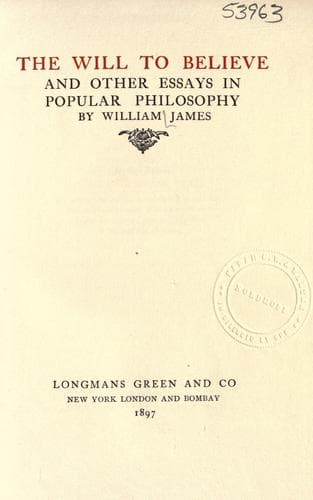
The Will to Believe, and Other Essays in Popular PhilosophyJames, William
Religion
The Will to Believe, and Other Essays in Popular Philosophy
James, William
Belief and doubt; Essays; Philosophy
With this we seem to have considered the possibilities of purely
theoretic rationality. But we saw at the outset that rationality meant
only unimpeded mental function. Impediments that arise in the
theoretic sphere might perhaps be avoided if the stream of mental
action should leave that sphere betimes and pass into the practical.
Let us therefore inquire what constitutes the feeling of rationality in
its _practical_ aspect. If thought is not to stand forever pointing at
the universe in wonder, if its movement is to be diverted from the
issueless channel of purely theoretic contemplation, let us ask what
conception of the universe will awaken active impulses capable of
effecting this diversion. A definition of the world which will give
back to the mind the free motion which has been blocked in the purely
contemplative path may so far make the world seem rational again.
Well, of two conceptions equally fit to satisfy the logical demand,
that one which awakens the active {76} impulses, or satisfies other
aesthetic demands better than the other, will be accounted the more
rational conception, and will deservedly prevail.
There is nothing improbable in the supposition that an analysis of the
world may yield a number of formulae, all consistent with the facts.
In physical science different formulae may explain the phenomena
equally well,--the one-fluid and the two-fluid theories of electricity,
for example. Why may it not be so with the world? Why may there not
be different points of view for surveying it, within each of which all
data harmonize, and which the observer may therefore either choose
between, or simply cumulate one upon another? A Beethoven
string-quartet is truly, as some one has said, a scraping of horses'
tails on cats' bowels, and may be exhaustively described in such terms;
but the application of this description in no way precludes the
simultaneous applicability of an entirely different description. Just
so a thorough-going interpretation of the world in terms of mechanical
sequence is compatible with its being interpreted teleologically, for
the mechanism itself may be designed.
If, then, there were several systems excogitated, equally satisfying to
our purely logical needs, they would still have to be passed in review,
and approved or rejected by our aesthetic and practical nature. Can we
define the tests of rationality which these parts of our nature would
use?
Public-domain text, read in full here on John Shaqi.
Reviews
Reviews
No reviews yet
Be the first to share your thoughts on this work.
Elsewhere in the archive
Join the Discussion
Join the discussion
Sign in to leave a comment or review.
Sign InorCreate an account