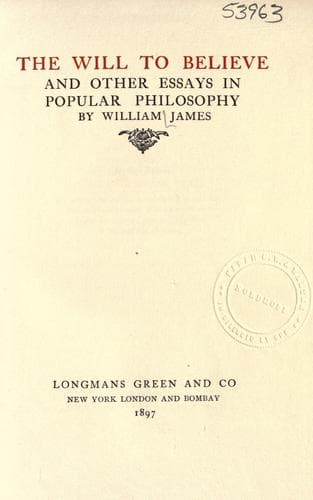
The Will to Believe, and Other Essays in Popular PhilosophyJames, William
Religion
The Will to Believe, and Other Essays in Popular Philosophy
James, William
Belief and doubt; Essays; Philosophy
Every reader must feel the truth of this. What is meant by coming 'to
feel at home' in a new place, or with new people? It is simply that,
at first, when we take up our quarters in a new room, we do not know
what draughts may blow in upon our back, what doors may open, what
forms may enter, what interesting objects may be found in cupboards and
corners. When after a few days we have learned the range of all these
possibilities, the feeling of strangeness disappears. And so it does
with people, when we have got past the point of expecting any
essentially new manifestations from their character.
The utility of this emotional effect of expectation is perfectly
obvious; 'natural selection,' in fact, was bound to bring it about
sooner or later. It is of the utmost practical importance to an animal
that he should have prevision of the qualities of the objects {79} that
surround him, and especially that he should not come to rest in
presence of circumstances that might be fraught either with peril or
advantage,--go to sleep, for example, on the brink of precipices, in
the dens of enemies, or view with indifference some new-appearing
object that might, if chased, prove an important addition to the
larder. Novelty _ought_ to irritate him. All curiosity has thus a
practical genesis. We need only look at the physiognomy of a dog or a
horse when a new object comes into his view, his mingled fascination
and fear, to see that the element of conscious insecurity or perplexed
expectation lies at the root of his emotion. A dog's curiosity about
the movements of his master or a strange object only extends as far as
the point of deciding what is going to happen next. That settled,
curiosity is quenched. The dog quoted by Darwin, whose behavior in
presence of a newspaper moved by the wind seemed to testify to a sense
'of the supernatural,' was merely exhibiting the irritation of an
uncertain future. A newspaper which could move spontaneously was in
itself so unexpected that the poor brute could not tell what new
wonders the next moment might bring forth.
Public-domain text, read in full here on John Shaqi.
Reviews
Reviews
No reviews yet
Be the first to share your thoughts on this work.
Elsewhere in the archive
Join the Discussion
Join the discussion
Sign in to leave a comment or review.
Sign InorCreate an account