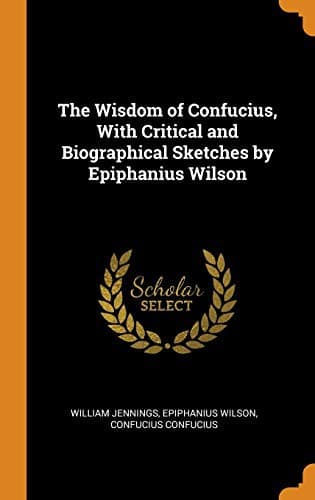
The Wisdom of Confucius: with Critical and Biographical SketchesConfucius
ReligionEastern
The Wisdom of Confucius: with Critical and Biographical Sketches
Confucius
Ethics -- China; Philosophy, Chinese
When Confucius heard of this he remarked, "He may well be esteemed a
'Wan.'"
The Master having made some reference to the lawless ways of Duke Ling
of Wei, Ki K‘ang said to him, "If he be like that, how is it he does
not ruin his position?"
Confucius answered, "The Chung-shuh, Yu, is charged with the
entertainment of visitors and strangers; the priest T‘o has charge
of the ancestral temple; and Wang-sun Kiá has the control of the army
and its divisions:--with men such as those, how should he come to ruin?"
He once remarked, "He who is unblushing in his words will with
difficulty substantiate them."
Ch‘in Shing had slain Duke Kien. Hearing of this, Confucius, after
performing his ablutions, went to Court and announced the news to Duke
Ngai, saying, "Ch‘in Shing has slain his prince. May I request that
you proceed against him?"
"Inform the Chiefs of the Three Families," said the duke.
Soliloquizing upon this, Confucius said, "Since he uses me to back his
ministers,[30] I did not dare not to announce the matter to him; and
now he says, 'Inform the Three Chiefs.'"
He went to the Three Chiefs and informed them, but nothing could be
done. Whereupon again he said, "Since he uses me to back his
ministers, I did not dare not to announce the matter."
Tsz-lu was questioning him as to how he should serve his prince.
"Deceive him not, but reprove him," he answered.
"The minds of superior men," he observed, "trend upwards; those of
inferior men trend downwards."
Again, "Students of old fixed their eyes upon themselves: now they
learn with their eyes upon others."
Kü Pih-yuh despatched a man with a message to Confucius. Confucius
gave him a seat, and among other inquiries he asked, "How is your
master managing?" "My master," he replied, "has a great wish to be
seldom at fault, and as yet he cannot manage it."
"What a messenger!" exclaimed he, admiringly, when the man went out.
"What a messenger!"
"When not occupying the office," was a remark of his, "devise not the
policy."
The Learned Tsang used to say, "The thoughts of the 'superior man' do
not wander from his own office."
"Superior men," said the Master, "are modest in their words, profuse
in their deeds."
Again, "There are three attainments of the superior man which are
beyond me--the being sympathetic without anxiety, wise without
scepticism, brave without fear."
"Sir," said Tsz-kung, "that is what you say of yourself."
Whenever Tsz-kung drew comparisons from others, the Master would say,
"Ah, how wise and great you must have become! Now I have no time to do
that."
Again, "My great concern is, not that men do not know me, but that
they cannot."
Again, "If a man refrain from making preparations against his being
imposed upon, and from counting upon others' want of good faith
towards him, while he is foremost to perceive what is passing--surely
that is a wise and good man."
Public-domain text, read in full here on John Shaqi.
Reviews
Reviews
No reviews yet
Be the first to share your thoughts on this work.
Join the Discussion
Join the discussion
Sign in to leave a comment or review.
Sign InorCreate an account