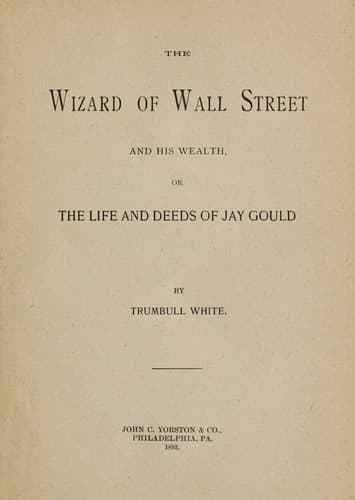
The Wizard of Wall Street and His Wealth; or, The Life and Deeds of Jay GouldWhite, Trumbull
History
The Wizard of Wall Street and His Wealth; or, The Life and Deeds of Jay Gould
White, Trumbull
Businessmen -- United States -- Biography; Capitalists and financiers -- United States -- Biography; Gould, Jay, 1836-1892
Speyer went about saying: “Some one has
threatened to shoot me. Let him shoot.” The Gold Exchange Bank was
obliged to suspend operations. Its clearances that day amounted to
over $300,000,000 of gold. Trading was stopped in the Gold Board. Fisk
& Belden suspended and their contracts were repudiated. The fortunes
of hundreds were swept away in that day’s battle. Several firms were
driven to the wall and announced their failures. The administration was
involved in suspicion which it took years to remove. The nation was
disgraced and its credit was broken.
But Gould, “the guilty plotter of all these criminal proceedings,” went
home saved. What he made or what he lost in that struggle is unknown,
but though he had involved others in ruin and had betrayed others, he
had saved himself from overthrow. To have gone down in the fight would
have been a display of heroism. To save himself alone from the wreck
was dishonor.
It is not strange that in his sworn autobiography delivered to the
Committee on Labor and Education, Mr. Gould omitted all mention of
Black Friday, but when as a witness before the Committee on Corners
he was asked about the Black Friday panic, he calmly said that it
was the “result of overtrading,” and that its real cause was “the
fluctuations in the price of gold caused by the war!” It is a singular
coincidence that exactly twenty-two years after Black Friday, on the
very anniversary of the day in 1891, Gould caused another big flurry in
Wall street. After several years of depression, a “boom” in stocks was
in progress, when the sudden announcement was made that the Missouri
Pacific, of which Gould was president, would pass its dividend. The
announcement caused a revolution in prices and the “boom” completely
collapsed.
Mr. Clews tells a graphic story of what he saw:
“On the morning of the fatal day, Belden and William Heath had an early
breakfast together at the Fifth Avenue Hotel, and repaired immediately
to their offices. Belden announced that gold was going to 200. ‘This
will be the last day of the Gold Room,’ he added. Moved by Belden’s
threat, a large number rushed to cover. In the language of Henry N.
Smith, ‘They came on with a rush to settle.’ He was settling in the
office of Smith, Gould & Martin, at 150 to 145, while Albert Speyer,
acting as broker for Fisk and Gould, was bidding up to 160 for a
million at a time. It was only when the price came down to 133 that
Speyer realized the humorous absurdity of his position. He had then
bought 26 millions since morning at 160.
Public-domain text, read in full here on John Shaqi.
Reviews
Reviews
No reviews yet
Be the first to share your thoughts on this work.
Join the Discussion
Join the discussion
Sign in to leave a comment or review.
Sign InorCreate an account