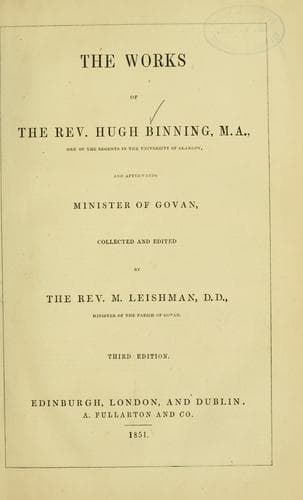
Presbyterian Church -- Sermons; Sermons, English; Theology -- Early works to 1800; Theology -- History -- 17th century
He was a person of exemplary moderation and sobriety of spirit, had
healing methods much at heart, and studied to promote love and peace among
his brethren in the ministry. He vigorously contributed to the recovery of
the humanity of Christianity, which had been much lost in the differences
of the times, and the animosities which followed thereupon. These virtues
and graces had such an ascendant in his soul, that when he carried coals
about with him, taken from the altar to warm the souls of all, with whom
he conversed, with love to God, his truths, interests and people, so he
carried sanctuary water about with him to cool and extinguish what of
undue passion he perceived to accompany the zeal of good and well
designing persons; a temper that is rarely found in one of his age. But
ripe harvest grapes were found upon this vine in the beginning of spring;
and no wonder, since he lived so near the Sun of Righteousness, and lay
under the plentiful showers of divine grace, and the ripening influences
of the Holy Spirit.
The prevailing of the English sectarians under Oliver Cromwell, to the
overthrow of the Presbyterian interest in England, and the various
attempts which they made in Scotland, on the constitution and discipline
of this church, was one of the greatest difficulties which the ministry
had then to struggle with. Upon this he made the following most excellent
reflection, in a Sermon preached on a day of public humiliation, “What if
the Lord hath defaced all that his kingdom was instrumental in building up
in England, that he alone may have the glory in a second temple more
glorious?”(111) And when he observed, that the zeal of many for the Solemn
League and Covenant, (by which they were sworn to endeavour the
preservation of the reformed religion in Scotland, and the reformation of
religion in the kingdoms of England and Ireland,) was not attended with a
suitable amendment of their own lives, he takes up a bitter lamentation
over them in a very remarkable paragraph. “Alas! we deceive ourselves with
the noise of a covenant, and a cause of God, we cry it up as an antidote
against all evils, use it as a charm, even as the Jews did their temple,
and in the mean time we do not care how we walk before God, or with our
neighbours. Well, thus saith the Lord, ‘Trust ye not in lying words,
saying, The temple of the Lord, the temple of the Lord, the temple of the
Lord are these. For if ye throughly amend your ways and your doings, if ye
throughly execute judgment between a man and his neighbour; if ye oppress
not the stranger, the fatherless, and the widow, and shed not innocent
blood in this place, neither walk after other gods to your hurt,’ &c. Jer.
vii. 4-6. If drunkenness reign among you, if filthiness, swearing,
oppression, cruelty reign among you, your covenant is but a lie, all your
professions are but lying words, and shall never keep you in your
inheritances and dwellings. The Lord tells you what he requires of you, is
Public-domain text, read in full here on John Shaqi.
Reviews
Reviews
No reviews yet
Be the first to share your thoughts on this work.
Join the Discussion
Join the discussion
Sign in to leave a comment or review.
Sign InorCreate an account