Presbyterian Church -- Sermons; Sermons, English; Theology -- Early works to 1800; Theology -- History -- 17th century
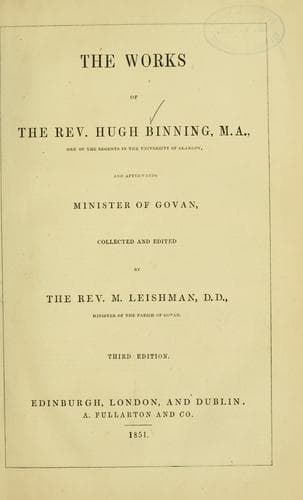
The first of his works that was printed,(122) is entitled, “The Common
Principles of the Christian Religion, clearly proved, and singularly
improved, or a Practical Catechism, wherein some of the most concerning
foundations of our faith are solidly laid down, and that doctrine which is
according to godliness, is sweetly, yet pungently pressed home, and most
satisfyingly handled.” Mr. M’Ward speaking of this performance, says,
“That it was not designed for the press, that it contained only his notes
on those subjects he preached to his flock, and which he wrote (I suppose
he means(123) in a fair hand) for the private use and edification of a
friend, from whom he had them, and when put into his hand to be revised,
he says, he did not so much as alter, or add one word, to make the sense
more plain, full, or emphatical.” This book is an excellent exposition of
the Westminster Catechism, so far as it goes, viz. to the twenty first
question, “Who is the Redeemer of God’s elect?” Mr. Patrick Gillespie
writes a preface to the reader, wherein he expresses his high opinion of
it in the following encomium. “In this book Mr. Binning explains many of
the fundamental articles of the Christian faith and had he lived to have
perfected and finished this work, he had been upon this single account
famous in the church of Christ.” The Assembly’s Catechism has had many
expositions by pious and learned ministers, some of them by way of sermon,
and others by way of question and answer. But this, so far as it goes, is
not inferior to any. A learned layman, Sir Matthew Hales chief justice of
the king’s bench, the divine of the state in King Charles II.’s reign,
judged the Assembly’s Catechism to be an excellent composure, and thought
it not below him, or unworthy of his pains to consider it. For in the
second part of his “Contemplations moral and divine,” we have his most
instructive meditations upon the first three questions. These had been the
employment of his _horœ sacrœ_, and it is a pity he did not go on to the
other questions. The shortness of Mr. Binning’s life has deprived us of a
complete course of useful catechetical discourses. This book was so
greatly esteemed in this country, that before the year 1718, there had
been no less than five impressions cast off the press,(124) and all these
being sold off, a sixth was made in the said year. As they were much
valued at home, so they were highly prized abroad, and as an evidence of
this, I find that Mr. James Coleman, minister at Sluys in Flanders,
translated them into the Dutch language.(125)
Public-domain text, read in full here on John Shaqi.
Reviews
Reviews
No reviews yet
Be the first to share your thoughts on this work.
Elsewhere in the archive
Join the Discussion
Join the discussion
Sign in to leave a comment or review.
Sign InorCreate an account