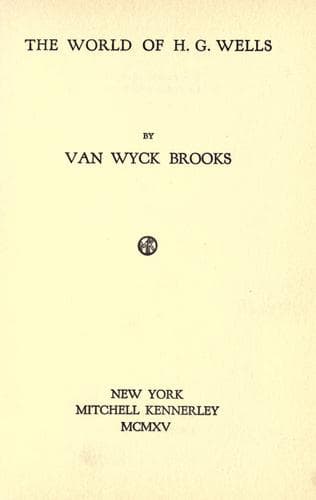
Science fiction, English -- History and criticism; Wells, H. G. (Herbert George), 1866-1946 -- Criticism and interpretation
That is the burden of his latest novel. By this touchstone he has come
to measure the possibility of that openness of mind, that mutual
understanding, that ventilation of life and thought through which alone
the Great State can exist.
CHAPTER VI
A PERSONAL CHAPTER
I doubt if there are many living men of note who, a generation after
they are dead, will be so fully and easily "explained" as H.G. Wells. He
is a most personal and transparent writer, he is the effect of
conditions and forces which have existed for scarcely more than two
generations. But for these very reasons it is very difficult to see him
in perspective, and to explain him would be to explain the age in which
we live. Let me at least give certain facts and reflections about his
life written by Wells himself, a few years ago, in the introduction to a
Russian translation of his writings:
I was born[1] in that queer indefinite class that we call in
England the middle class. I am not a bit aristocratic; I do
not know any of my ancestors beyond my grandparents, and
about them I do not know very much, because I am the
youngest son of my father and mother and their parents were
all dead before I was born. My mother was the daughter of an
innkeeper at a place called Midhurst, who supplied
post-horses to the coaches before the railways came; my
father was the son of the head gardener of Lord de Lisle at
Penshurst Castle, in Kent. They had various changes of
fortune and position; for most of his life my father kept a
little shop in a suburb of London, and eked out his
resources by playing a game called cricket, which is not
only a pastime, but a show which people will pay to see, and
which, therefore, affords a living to professional players.
His shop was unsuccessful, and my mother, who had been a
lady's maid, became, when I was twelve years old,
housekeeper in a large country house. I too was destined to
be a shopkeeper. I left school at thirteen for that purpose.
I was apprenticed first to a chemist, and, that proving
unsatisfactory, to a draper. But after a year or so it
became evident to me that the facilities that were and still
are increasing in England offered me better chances in life
than a shop and comparative illiteracy could do; and so I
struggled for and got various grants and scholarships that
enabled me to study and take a degree in science and some
mediocre honors in the new and now great and growing
University of London.... After I had graduated I taught
biology for two or three years, and then became a
journalist.... I began first to write literary articles,
criticisms, and so forth, and presently short imaginative
stories in which I made use of the teeming suggestions of
modern science....
So much for the facts. The reflections are not less illuminating:
Public-domain text, read in full here on John Shaqi.
Reviews
Reviews
No reviews yet
Be the first to share your thoughts on this work.
Elsewhere in the archive
Join the Discussion
Join the discussion
Sign in to leave a comment or review.
Sign InorCreate an account