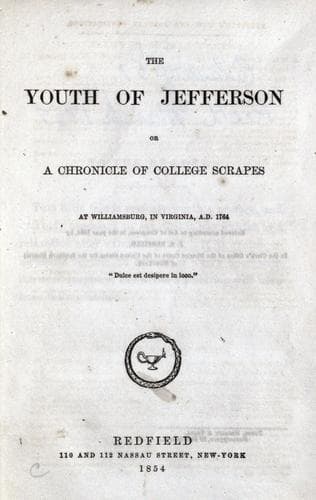
The Youth of Jefferson: Or, a Chronicle of College Scrapes at Williamsburg, in Virginia, A.D. 1764Cooke, John Esten
General
The Youth of Jefferson: Or, a Chronicle of College Scrapes at Williamsburg, in Virginia, A.D. 1764
Cooke, John Esten
Jefferson, Thomas, 1743-1826 -- Fiction
"You came near walking into the brook," said Belle-bouche, with her
languishing smile; "what, pray, were you thinking of?"
"Of you," sighed Jacques.
The little beauty blushed.
"Oh, then your time was thrown away," she said; "you should not busy
yourself with so idle a personage."
"Ah!" sighed Jacques, "how can I help it?"
"What a lovely day!" said Belle-bouche, in order to divert the
conversation. "Aunt and myself thought we'd come down to the quarters
and see the sick. I carried mammy Lucy some nice things, and aunt went
on to see about some spinning, and I came here to look over this book
of songs, which I have just got from London."
"Songs?" said Jacques, with deep interest, and bending down until his
lips nearly touched the little hand; "songs, eh?"
"Scottish songs," laughed Belle-bouche; "and when you came I was
reading this one, which seems to be the chronicle of a very
unfortunate gentleman."
With which words Belle-Bouche, laughing gaily, read:
"Now Jockey was a bonny lad
As e'er was born in Scotland fair;
But now, poor man, he's e'en gone woad,
Since Jenny has gart him despair.
"Young Jockey was a piper's son,
And fell in love when he was young;
But a' the spring that he could play
Was o'er the hills and far away!"
And ending, Belle-bouche handed the book, with a merry little glance,
to Jacques, who sighed profoundly.
"Yes, yes!" he murmured, "I believe you are right--true, it _is_ about
a very unfortunate shepherd--all lovers are unfortunate. These seem to
be pretty songs--very pretty."
And he disconsolately turned over the leaves; then stopped and began
reading.
"Here is one more cheerful," he said; "suppose I read it, my dear Miss
Belle-bouche."
And he read:
"'Twas when the sun had left the west,
And starnies twinkled clearie, O,
I hied to her I lo'e the best,
My blithesome, winsome dearie, O.
"Her cherry lip, her e'e sae blue,
Her dimplin' cheek sae bonnie, O,
An' 'boon them a' her heart sae true,
Hae won me mair than ony, O."
"Pretty, isn't it?" sighed Jacques; "but here is another verse:
"Yestreen we met beside the birk,
A-down ayont the burnie, O,
An' wan'er't till the auld gray kirk
A stap put to our journie, O.
"Ah, lassie, there it stans! quo' I----"
With which words Jacques shut the book, and threw upon Belle-bouche a
glance which made that young lady color to the roots of her hair.
"I think we had better go," murmured Belle-bouche, rising; "I have to
fix for the ball----"
"Not before----!"
"No, not before Tuesday, I believe," said Belle-bouche; "I am glad
they changed it from Monday."
Jacques drew back, sighing; but returning to the attack, said in an
expiring voice:
"What will my Flora wear--lace and flowers?"
"Who is she?" said Belle-bouche, putting on her light chip hat and
tying the ribbon beneath her dimpled chin.
Public-domain text, read in full here on John Shaqi.
Reviews
Reviews
No reviews yet
Be the first to share your thoughts on this work.
Elsewhere in the archive
Join the Discussion
Join the discussion
Sign in to leave a comment or review.
Sign InorCreate an account