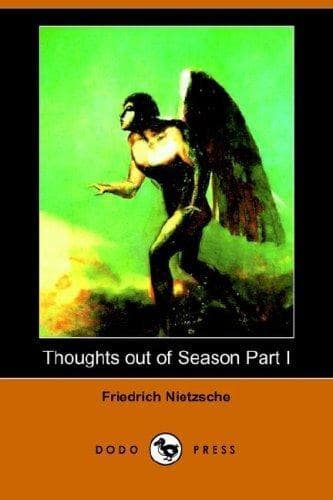
Thoughts out of Season, Part INietzsche, Friedrich Wilhelm
PhilosophyPhilosophy
Thoughts out of Season, Part I
Nietzsche, Friedrich Wilhelm
Philosophy, German; Strauss, David Friedrich, 1808-1874; Wagner, Richard, 1813-1883
Says Strauss: "I should say that all moral action arises from the
individual's acting in consonance with the idea of kind" (p. 274). Put
quite clearly and comprehensively, this means: "Live as a man, and not
as an ape or a seal." Unfortunately, this imperative is both useless
and feeble; for in the class Man what a multitude of different types
are included--to mention only the Patagonian and the Master, Strauss;
and no one would ever dare to say with any right, "Live like a
Patagonian," and "Live like the Master Strauss"! Should any one,
however, make it his rule to live like a genius--that is to say, like
the ideal type of the genus Man--and should he perchance at the same
time be either a Patagonian or Strauss himself, what should we then
not have to suffer from the importunities of genius-mad eccentrics
(concerning whose mushroom growth in Germany even Lichtenberg had
already spoken), who with savage cries would compel us to listen to
the confession of their most recent belief! Strauss has not yet
learned that no "idea" can ever make man better or more moral, and
that the preaching of a morality is as easy as the establishment of it
is difficult. His business ought rather to have been, to take the
phenomena of human goodness, such--for instance--as pity, love, and
self-abnegation, which are already to hand, and seriously to explain
them and show their relation to his Darwinian first principle. But no;
he preferred to soar into the imperative, and thus escape the task of
explaining. But even in his flight he was irresponsible enough to soar
beyond the very first principles of which we speak.
"Ever remember," says Strauss, "that thou art human, not merely a
natural production; ever remember that all others are human also, and,
with all individual differences, the same as thou, having the same
needs and claims as thyself: this is the sum and the substance of
morality" (p. 277). But where does this imperative hail from? How can
it be intuitive in man, seeing that, according to Darwin, man is
indeed a creature of nature, and that his ascent to his present stage
of development has been conditioned by quite different laws--by the
very fact that be was continually forgetting that others were
constituted like him and shared the same rights with him; by the very
fact that he regarded himself as the stronger, and thus brought about
the gradual suppression of weaker types. Though Strauss is bound to
admit that no two creatures have ever been quite alike, and that the
ascent of man from the lowest species of animals to the exalted height
of the Culture--Philistine depended upon the law of individual
distinctness, he still sees no difficulty in declaring exactly the
reverse in his law: "Behave thyself as though there were no such
things as individual distinctions." Where is the Strauss-Darwin
morality here? Whither, above all, has the courage gone?
Public-domain text, read in full here on John Shaqi.
Reviews
Reviews
No reviews yet
Be the first to share your thoughts on this work.
Join the Discussion
Join the discussion
Sign in to leave a comment or review.
Sign InorCreate an account