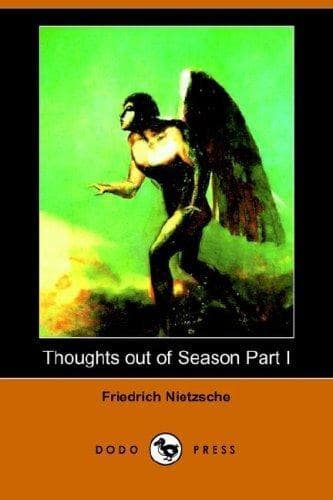
Thoughts out of Season, Part INietzsche, Friedrich Wilhelm
PhilosophyPhilosophy
Thoughts out of Season, Part I
Nietzsche, Friedrich Wilhelm
Philosophy, German; Strauss, David Friedrich, 1808-1874; Wagner, Richard, 1813-1883
In the very next paragraph we find further evidence tending to show us
the point at which this courage veers round to its opposite; for
Strauss continues: "Ever remember that thou, and all that thou
beholdest within and around thee, all that befalls thee and others, is
no disjointed fragment, no wild chaos of atoms or casualties, but
that, following eternal law, it springs from the one primal source of
all life, all reason, and all good: this is the essence of religion"
(pp. 277-78). Out of that "one primal source," however, all ruin and
irrationality, all evil flows as well, and its name, according to
Strauss, is Cosmos.
Now, how can this Cosmos, with all the contradictions and the
self-annihilating characteristics which Strauss gives it, be worthy of
religious veneration and be addressed by the name "God," as Strauss
addresses it?--"Our God does not, indeed, take us into His arms from
the outside (here one expects, as an antithesis, a somewhat miraculous
process of being "taken into His arms from the inside"), but He
unseals the well-springs of consolation within our own bosoms. He
shows us that although Chance would be an unreasonable ruler, yet
necessity, or the enchainment of causes in the world, is Reason
itself." (A misapprehension of which only the "We" can fail to
perceive the folly; because they were brought up in the Hegelian
worship of Reality as the Reasonable--that is to say, in the
canonisation of success.) "He teaches us to perceive that to demand an
exception in the accomplishment of a single natural law would be to
demand the destruction of the universe" (pp. 435-36). On the contrary,
Great Master: an honest natural scientist believes in the
unconditional rule of natural laws in the world, without, however,
taking up any position in regard to the ethical or intellectual value
of these laws. Wherever neutrality is abandoned in this respect, it is
owing to an anthropomorphic attitude of mind which allows reason to
exceed its proper bounds. But it is just at the point where the
natural scientist resigns that Strauss, to put it in his own words,
"reacts religiously," and leaves the scientific and scholarly
standpoint in order to proceed along less honest lines of his own.
Without any further warrant, he assumes that all that has happened
possesses the highest intellectual value; that it was therefore
absolutely reasonably and intentionally so arranged, and that it even
contained a revelation of eternal goodness. He therefore has to appeal
to a complete cosmodicy, and finds himself at a disadvantage in regard
to him who is contented with a theodicy, and who, for instance,
regards the whole of man's existence as a punishment for sin or a
process of purification. At this stage, and in this embarrassing
position, Strauss even suggests a metaphysical hypothesis--the driest
and most palsied ever conceived--and, in reality, but an unconscious
parody of one of Lessing's sayings. We read on page 255: "And that
Public-domain text, read in full here on John Shaqi.
Reviews
Reviews
No reviews yet
Be the first to share your thoughts on this work.
Join the Discussion
Join the discussion
Sign in to leave a comment or review.
Sign InorCreate an account