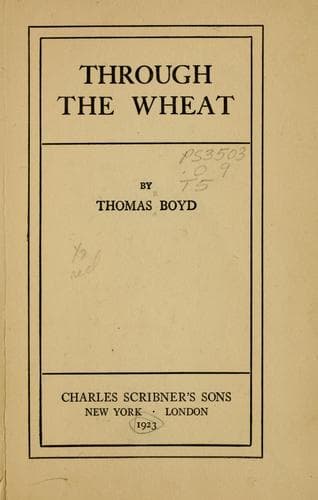
United States. Marine Corps -- Fiction; War stories; World War, 1914-1918 -- Fiction
The fighting grew more furious. Germans, surprised, were hiding behind
trees and firing their slow-working rifles. When the advancing line would
reach them they would receive a charge of shot in their bodies, sometimes
before they had fired at the swiftly moving line. Some member of the
platoon offered his version of an Indian war whoop. It was successful
in hastening the attack. Exhilarated, but sheerly impotent, one man ran
forward blubbering, “You God-damn Germans,” and pointing an empty rifle
at the trees. Other men calmly and methodically worked the bolts of their
rifles back and forth, refilling the chambers as they were emptied of
each clip of five shots. From time to time a man dropped, thinning the
ranks and spreading them out to such an extent that contact on the right
side of the moving line was lost.
Farther on in the woods a small trench had been dug, but through the
fierceness and unexpectedness of the attack most of the enemy had been
driven from it. The platoon, moving on feet that felt like wings, dashed
toward the trench, some of the men sprawling into it. Before them, a few
yards distant, a machine-gun poked its nose from between the crevice of
two large rocks. The sight of it infuriated Lieutenant Bedford, who was
leading the platoon by a few paces. Then, yards away, he began throwing
bombs at it. His last bomb exhausted, he aimed his pistol and chucked
the remaining shots at it. Now, almost able to look over the top of the
rock and see the gunner, he threw the useless pistol at the heavy steel
helmet. The gunner dropped his head, covering it with his hands. When he
looked up, the platoon had passed. Farther, the resistance grew less. The
bombardment of the night before had taken its toll of Germans. Bodies
lay gawkily about on the grass. One body, headless, clutched a clay pipe
between its fingers. Another lay flat on its back, a hole in its stomach
as big as a hat. A heavy leather pack, which a shell had struck, was the
centre of a ring of packages of Piedmont cigarettes which its owner had
salvaged from some dead American.
The trees became sparse. Ahead, over an interminably long wheat-field,
the platoon could see the horizon. There were no Germans in sight. The
platoon, ordered to do so, faced in the direction from which they had
come and combed the woods for machine-gun nests which they might have
passed unnoticed during the attack.
Public-domain text, read in full here on John Shaqi.
Reviews
Reviews
No reviews yet
Be the first to share your thoughts on this work.
Join the Discussion
Join the discussion
Sign in to leave a comment or review.
Sign InorCreate an account