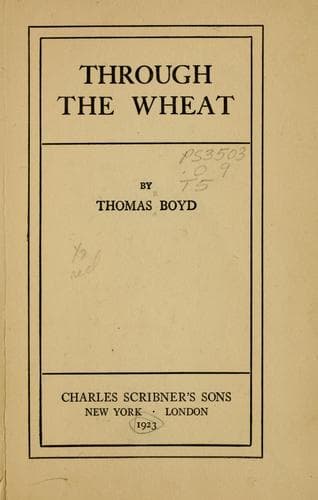
United States. Marine Corps -- Fiction; War stories; World War, 1914-1918 -- Fiction
Beyond a cluster of trees was a village which had been named as the
objective of the attack for that day. The road, canopied by green tree
boughs, led to it from the town which that morning the platoon had left.
The road was level, more level even than the field. It made a path as
directing as a bowling-alley for the machine-gunners and riflemen in the
village. Thus, the road was almost a certain death-trap for any one who
tried to cross it. The right section of the platoon had begun the attack
on one side of the road, the left on the other. As the ranks thinned and
a greater distance between each man was required to preserve contact
with the advancing line, the men on the right, where the heavier firing
occurred, spread out, drawing away from the road.
The shells continued to fall, using as their target the slowly moving
tanks which regulated the advance of the infantry. Suddenly a large
six-inch shell struck the turret of the tank nearest the platoon. The
tank recoiled and stood stock-still. A moment later two men, like
frightened rabbits, scurried out of the tank and ran back toward the rear.
Three airplanes, white stars in a field of red on their wings, flew gaily
over the field and toward the German lines. They floated gracefully
and haughtily out of sight. Not much later on they precipitately
returned with three Fokkers after them like angry hornets. Shriven of
their grandeur, they flocked in disorder back to their hangars, the
machine-guns of the German planes spitting bullets after them. The aerial
entertainment was changed: Four large German bombing planes, pursuing a
businesslike course, arrived above the advancing men and began to drop
bombs and fire machine-gun bullets at them. The bombs reported as noisily
as the seventy-seven-millimetre guns, but they made only a shallow hole
in the ground. More devastating were the machine-gun bullets which zinged
off the steel helmets of the men or bored their way through to the skull.
Under the combination of direct artillery fire, enfilade machine-gun,
rifle sniping, bombs dropped from airplanes, the ranks of the advancing
men had become so sparse that the attack was brought to a temporary halt.
It was now afternoon and the heat of the sun was unendurable. It burned
upon the helmets and through the clothing and caused sweat to trickle
down the skin, irritating the scratches, bruises, and burns with which
the bodies of the men were covered. The four bombing planes continued
lazily to circle overhead, “kicking out their tail-gates,” as the men
graphically phrased it. Hicks and Pugh, with four of the new men, were
at the farthest point of advance. Lying flat, they tried with their
bayonets, their mess knives, to throw up a protection of ground in front
of them. Thoroughly tired, they worked slowly, in spite of the danger.
They were half-way finished when a bullet zipped through the wheat and
penetrated the bone of the crooked elbow with which the man next Hicks
was supporting himself.
Public-domain text, read in full here on John Shaqi.
Reviews
Reviews
No reviews yet
Be the first to share your thoughts on this work.
Elsewhere in the archive
Join the Discussion
Join the discussion
Sign in to leave a comment or review.
Sign InorCreate an account