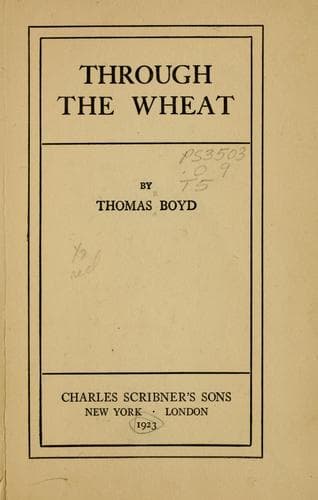
United States. Marine Corps -- Fiction; War stories; World War, 1914-1918 -- Fiction
Ahead of him, at the side of a green knoll, several old Frenchmen were
pottering around a field kitchen. The coals of the wood fire under a huge
black kettle glowed in a warming, friendly fashion. The aroma of black,
satisfying coffee steamed from the wide mouth of the caldron. Hicks was
enchanted, powerless to move, afraid to approach the benignant genii. He
felt like a vagrant, nose pressed against the window of a fashionable
restaurant. But no, not like a vagrant. Vagrants were only in cities,
in blessed civilizations. He was still undecided, when one of the squat
little figures, that somehow reminded him of the characters in “Rip Van
Winkle,” looked up. To Hicks he spoke unintelligibly, but his voice was
not forbidding. Hicks came nearer. He sniffed. “Café?” he questioned.
“Oui, café,” the man grunted, going on about his business.
“Café bon,” offered Hicks.
“Oui. Café bon, très bon,” the man conceded.
“J’ai faim.”
“O pardon. Vous avez faim. Voulez-vous café?” He scooped a ladleful of
hot coffee from the caldron and offered it to Hicks. How simple it was,
Hicks thought, as he drained the dipper.
The men gathered around Hicks. “Américain, oui?” They apparently had
decided before offering the question. “Pas Anglais? Anglais mauvais.”
They learned that he had been in the attack. “Boche pas bon aussi, non?”
From their bags cakes of chocolate and slices of bread were brought and
offered. Hicks ate shyly but greedily.
They were the first Frenchmen whom he had tried to talk with since the
day of the first attack of his platoon. Then they were disheartened, not
caring whether the Germans drank beer from the Arc de Triomphe or not.
Now they had regained heart and were willing to continue the struggle
of the advance toward Germany. Hicks learned that he had engaged in the
initial attack of a vast offensive, that the goal had been reached, that
Soissons had fallen under the storm of the First and Second Regular
Divisions, that Château-Thierry had at last been cleared of the enemy by
the Third and Twenty-sixth Divisions, that in between the Fourth Regular
Division had been successful in its attack. “Fini la guerre?” asked
Hicks, and he was frowned upon by the genii. No, they informed him, the
war had begun anew and would continue long. The genii spoke of the black
forest, of the Kriemhilde Stellung, which had never been passed save by
Allied prisoners, of the narrowing front the German retreat would make.
No, the war would last one year, two years, three years.
* * * * *
Public-domain text, read in full here on John Shaqi.
Reviews
Reviews
No reviews yet
Be the first to share your thoughts on this work.
Elsewhere in the archive
Join the Discussion
Join the discussion
Sign in to leave a comment or review.
Sign InorCreate an account