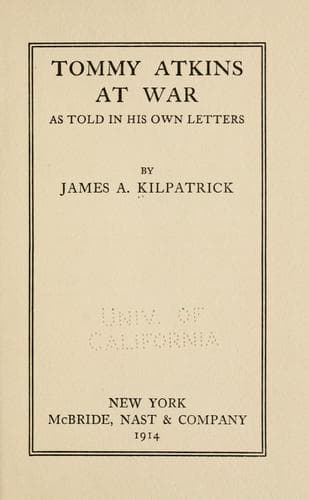
Tommy Atkins at War: As Told in His Own LettersKilpatrick, James Alexander
History
Tommy Atkins at War: As Told in His Own Letters
Kilpatrick, James Alexander
Great Britain. Army -- Military life; World War, 1914-1918
There is something strange, mysterious, and insubstantial about the war
in the air that the soldiers do not yet feel or comprehend. Often the
feverish activity of aircraft at a high altitude is known only to a very
few practised observers. A gentle purring in the air and the scarcely
audible ping-pong of distant revolver shots may represent a fierce duel
in the clouds, and often the soldiers are unaware of the presence of a
hostile airman until the projectiles aimed at them burst in the
trenches. One evening, a graphic official message states, the atmosphere
was so still and clear that only those specially on the lookout detected
the enemy's aeroplanes, and when the bombs burst "the puffs of smoke
from the detonating shell hung in the air for minutes on end like balls
of fleecy cottonwool before they slowly expanded and were dissipated."
Of course, the tactics adopted for dealing with hostile aircraft are to
attack them instantly with one or more British machines, and as in this
respect the British Flying Corps has established an individual
ascendency, Sir John French proudly declares that "something in the
direction of the mastery of the air has already been gained."
XIII
TOMMY AND HIS RATIONS
A medical officer at the front declares that the British Expeditionary
Force is, without doubt, the "best fed Army that has ever taken the
field." That is a sweeping statement, but it is true. It is confirmed
over and over again in the letters of Tommy Atkins. It is acknowledged
by the French. Even the most sullen German prisoners agree with it.
There has been universal praise for the quality and abundance of the
food, and the general arrangements for the comfort of the British
soldier.
One French description of the feeding says that the English troops "live
like fighting cocks," another marvels at "the stupendous pieces of meat,
and bread heavy with butter and jam," a third speaks of the "amazing
Tommees" who "carry everything in their pockets and forget nothing at
all." And so on.
But the most remarkable tribute of all to the perfect working of the
transport and supply service is that given by the British officers and
men themselves. Captain Guy Edwards, Coldstream Guards, says: "They have
fed our troops wonderfully regularly and well up to the present; we have
had no sickness at all, and every one is in splendid spirits." In
another letter an officer refers to the generosity of the rations. "In
addition to meat and bread (or biscuit)," he says, "we get 1/4lb. jam,
1/4lb. bacon, 3oz. cheese, tea, etc., while the horses have had a good
supply of oats and hay." During the whole of the long retreat from Mons,
says an officer of the Berkshires, "there was only one day when we
missed our jam rations!"
And it is the same with the men. Here are some brief extracts from their
letters:
Private ----, 20th Field Ambulance:
Public-domain text, read in full here on John Shaqi.
Reviews
Reviews
No reviews yet
Be the first to share your thoughts on this work.
Join the Discussion
Join the discussion
Sign in to leave a comment or review.
Sign InorCreate an account