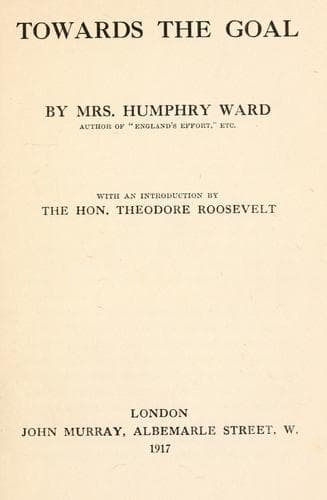
World War, 1914-1918 -- Campaigns -- Western Front; World War, 1914-1918 -- Personal narratives
"How can I describe it? Where to begin? Abandoned farms, on hills of
death! The grain-giving earth, empty of human beings. No labourers--no
household smoke. The fire of the burning villages has smouldered out,
and round the houses, and in the courtyards, lie the debris of their
normal life, trampled, dirty and piecemeal, under foot. Poor farms of
the Ile-de-France!--dwellings of old time, into whose barns the rich
harvests of the fields had been joyously gathered year by year--old
tiled roofs, clothed with ancestral moss--plain hospitable rooms where
masters and servants met familiarly together:--you are no more than
calcined and blackened stones! Not a living animal in the ruined stalls,
not an ox, not a horse, not a sheep. One flies from the houses, only to
find a scene more horrible in the fields. Corpses everywhere, of men and
horses. And everywhere in the fields unexploded shells, which it would
be death to touch, which have already made many unsuspecting victims.
"Sometimes, as the motor draws near, a man or a woman emerges from a
building, having still on their faces the terror of the hours they have
lived through. They scarcely look at us. They are absorbed in their
losses, in the struggle to rescue something from the wreck. As soon as
they are sure it is not the Germans come back, they turn away, with slow
steps, bewildered by what they have suffered."
The small party in the motor includes a priest, and as it passes near
Betz, at the northern end of the battle-field, they see a burying-party
of French Territorials at work. The officer in charge beckons to the
priest, and the priest goes to speak to him.
"Monsieur l'Abbé, we have just buried here twenty-two French soldiers."
He points to a trench freshly dug, into which the earth has just been
shovelled.
"They are Breton soldiers," the officer explains, "and the men of my
burying company are Bretons too. They have just discovered that these
dead men we have gathered from the fields were soldiers from a regiment
recruited in their own district. And _seven_ of them have recognised
among these twenty-two dead, one a son, one a son-in-law, one a brother.
Will you come, Monsieur l'Abbé, and say a few words to these
poor fellows?"
So the Abbé goes to the new-made grave, reads the _De Profundis_, says a
prayer, gives the benediction, and then speaks. Tears are on the strong,
rugged faces of the bare-headed Bretons, as they gather round him. A
group, some little distance off, which is writing the names of the dead
on a white cross, pauses, catches what is going on, and kneels too, with
bent heads....
It is good to linger on that little scene of human sympathy and
religious faith. It does something to protect the mind from the horror
of much that has happened here.
* * * * *
Public-domain text, read in full here on John Shaqi.
Reviews
Reviews
No reviews yet
Be the first to share your thoughts on this work.
Join the Discussion
Join the discussion
Sign in to leave a comment or review.
Sign InorCreate an account