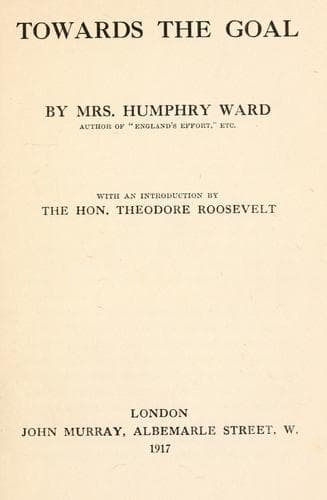
World War, 1914-1918 -- Campaigns -- Western Front; World War, 1914-1918 -- Personal narratives
Every one of the six Armies aligned across France, from
Paris to the Grand Couronne, had its own glorious task in the defeat of
the German plans. But we were then so small a proportion of the whole,
with our hundred and twenty thousand men, and we have become since so
accustomed to count in millions, that perhaps our part in the "miracle
of the Marne" is sometimes in danger of becoming a little blurred in the
popular English--and American--conception of the battle. Is not the
truth rather that we had a twofold share in it? It was Von Kluck's
miscalculation as to the English strength that tempted him to his
eastward march; it was the quality of the British force and leadership,
when Sir John French's opportunity came, that made the mistake a
fatal one.
How different the aspect of the Ourcq plateau at the opening of the
battle in 1914, from the snowy desolation under which we saw it! Perfect
summer weather--the harvest stacks in the fields--a blazing sun by day,
and a clear moon by night. For the first encounters of the five days'
fighting, till the rain came down, Nature could not have set a fairer
scene. And on the two anniversaries which have since passed, summer has
again decked the battle-field. Thousands have gone out to it from Paris,
from Meaux, and the whole country-side. The innumerable graves, single
or grouped, among the harvest fields and the pastures, have been covered
with flowers, and bright, mile after mile, with the twinkling tricolour,
as far as the eye could see. At Barcy and Etrépilly, the centres of the
fight, priests have blessed the graves, and prayed for the dead.
There has been neither labour nor money indeed as yet wherewith to
rebuild the ruined villages and farms, beyond the most necessary
repairs. They stand for the most part as the battle left them. And the
fields are still alive with innumerable red flags--distinct from the
tricolour of the graves--which mark where the plough must avoid an
unexploded shell. In a journal of September 1914, a citizen of Senlis
describes passing in a motor through the scene of the fight, immediately
after the departure of the Germans, when the scavenging and burying
parties were still busy.
Public-domain text, read in full here on John Shaqi.
Reviews
Reviews
No reviews yet
Be the first to share your thoughts on this work.
Join the Discussion
Join the discussion
Sign in to leave a comment or review.
Sign InorCreate an account