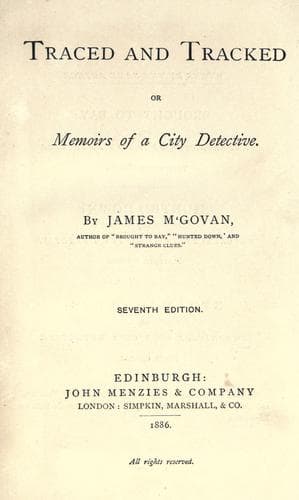
Traced and Tracked; Or, Memoirs of a City DetectiveM'Govan, James
General
Traced and Tracked; Or, Memoirs of a City Detective
M'Govan, James
Detective and mystery stories; Edinburgh (Scotland) -- Fiction
The mother appeared stunned and stupefied by the discovery that she
had helped to rivet fetters on him, and that he was likely to be
tried for housebreaking with an alternative charge of theft. How the
charge came to assume this form is the most striking and curious
feature of the case. As soon as I got the two addresses I went first
to the home of the prisoner, Alfred Scott, and searched in vain for
the rest of the plunder; then I went to his employer’s workshop, and
unearthed the treasure-trove from a most ingenious hiding-place under
a pile of wood which took us ten minutes to remove. Everything was
there but the gold chain and the servant’s silver ring, and the whole
were still wrapped up in Shorty’s spotted cotton handkerchief, which
unfortunately did not bear either name or address. But this discovery
was not the most important made at that place. From Scott’s master we
learned that our prisoner, along with a journeyman, had been employed
making some alterations or repairs in the major’s house about six
months before the robbery. The natural inference then was that he
upon that occasion had provided himself with casts of some of the
keys, and so prepared to commit the robbery—hence the framing of the
charge on the serious lines I have indicated.
As soon as these facts were made plain, and when the major had
identified Scott as one of the joiners who had worked in his house, I
went to Shorty’s cell and said that we had got the thief, and that in
all probability he and The Fin would be soon at liberty.
Shorty received the news not with the satisfaction I had expected,
but with a stony stare which seemed to me absolutely idiotic. He made
no remark of any kind, and showed neither gratitude nor resentment.
It turned out, however, that he and The Fin did not get off so
easily, but were convicted and sent for thirty days to prison for
“loitering with intent.”
Meanwhile Scott persisted in his fatal and blundering silence, and
his case came on for trial. He pleaded “not guilty,” and the case
went to proof, when the evidence, which, link by link, appeared
to demonstrate his guilt beyond the shadow of a doubt, took him
completely by surprise. There was the selling of the chain; his
contradictions and prevarications; the finding of the plunder, and
the fact that he had worked on the premises—all damning.
The summing up of the evidence had been completed, and the jury
were about to find him guilty without leaving the box, when Scott
excitedly asked to be allowed to make a statement in his defence.
Public-domain text, read in full here on John Shaqi.
Reviews
Reviews
No reviews yet
Be the first to share your thoughts on this work.
Join the Discussion
Join the discussion
Sign in to leave a comment or review.
Sign InorCreate an account