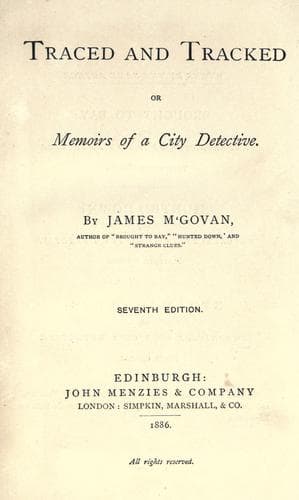
Traced and Tracked; Or, Memoirs of a City DetectiveM'Govan, James
General
Traced and Tracked; Or, Memoirs of a City Detective
M'Govan, James
Detective and mystery stories; Edinburgh (Scotland) -- Fiction
“Ye’ll have to take another county, Dickie, darlint,” he said, after
they had discussed the matter, and found some action imperative.
“I’m not afeard of ye running away an’ forgetting your poor owld
grandfather. I’ve teached ye better nor that, more by token they can
never expect to prosper that wrongs the helpless or the suffering.”
“May I drop dead the minute such a thought enters my head!” said
Dickie with energy. “Rest where you are, Jerry dear—and get well and
take all the comfort ye can, for sure ye’ve been a blessed friend to
me, and made a man of me when I’d have turned out nothing but a jail
bird and a vagabone.”
The “man,” as he termed himself, was then just twelve years of age,
but his sentiments, as the reader will admit, were worthy of twice
that number of years.
Thus it was that Dickie came to face the world as an independent
traveller. He moved over a great part of Ireland in this way, always
sending the net gains regularly to old Jerry, and, on the whole,
doing nearly as well as before the separation. He almost invariably
met with kindness and sympathy, but once he was attacked and robbed
of three days’ earnings. But in taking the money the wretches took
also Dickie’s carefully cherished talisman, the broken cairngorm, and
by that they were identified and convicted, while the trinket was
returned to Dickie, who cherished it and guarded it, with greater
faith than ever in its power. He would not have parted with that
senseless bit of stone for a twenty-pound note, for it was the only
link which connected the present with the past, and he never looked
at it, as he was wont to declare, without remembering what he might
have been but for old Jerry.
“Faith, I believe if I were to lose that stone my good luck would go
with it,” he repeatedly asserted, from which it will be seen that
there was mixed up with Dickie’s well-doing a spice of superstition,
which, however, is not a bad thing, when it keeps in the straight
path feet inclined to wander.
On one of the rare occasions when Dickie was able to get back as far
as Belfast to see Jerry, he found the old grinder unusually weak and
worn. Hitherto Jerry had doctored his leg himself, but now it had
assumed such a strange appearance that he was glad to have Dickie by
his side to advise him. It had begun to grow black, and, what was
more strange, the pain had all gone out of it. Dickie had been doing
pretty well on his travels, so he promptly decided that they should
call in a doctor.
When that gentleman came he looked at the leg, and then at the
emaciated face of the old man, and then said compassionately—
“Why did you send for me?”
“To mend me leg, plase God,” said Jerry.
The doctor quietly covered up the limb and shook his head.
“Ye’ve more need of a praist, good man,” he said, shortly, but not
unkindly. “No doctor alive will ever make you well.”
Public-domain text, read in full here on John Shaqi.
Reviews
Reviews
No reviews yet
Be the first to share your thoughts on this work.
Elsewhere in the archive
Join the Discussion
Join the discussion
Sign in to leave a comment or review.
Sign InorCreate an account