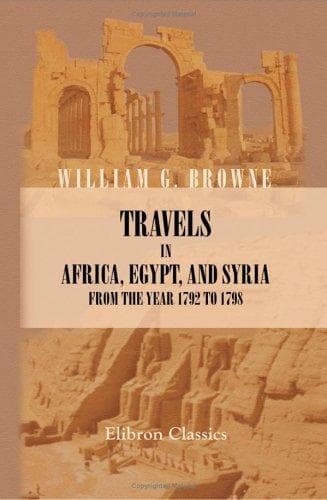
Travels in Africa, Egypt, and Syria, from the year 1792 to 1798Browne, William George
History
Travels in Africa, Egypt, and Syria, from the year 1792 to 1798
Browne, William George
Egypt -- Description and travel; Sudan -- Description and travel; Syria -- Description and travel
The mint is fixed in the castle, built by the celebrated _Yussuf
abu Moddafar ibn Aiûb_, whose title of honour was Salah-eddîn,
in the sixth century of Mohammedism. The people of the country,
who are in the habit of confounding all history and chronology,
attribute it to Joseph the son of Isaac, whose palace they say it
was; but it is unnecessary to confute an opinion wholly unsupported
by facts. Including the quarters of the Janizaries and Assabs (the
latter of whom no longer exist), the building occupies a large
space. But it is irregular, and the Pasha’s apartments are mean
and incommodious. The well is of great depth, and has been hewn with
much labour through the solid rock, but as that rock is of a soft
nature, the magnitude of the work is not comparable to that of some
excavations which have been executed in several other places. The
broken remains of the palace of Salah-eddîn, are indeed worthy of
remark. An apartment of great length overlooks the city, the river,
and the adjacent country; and several beautiful columns raise their
heads out of the general wreck. In a chamber of this building is
fabricated the embroidered cloth, which the munificence of the Porte
annually devotes to the use of the _Kaba_.
Misr-el-Attiké, to the South of the present city, is pleasantly
situated, and well inhabited. It can now only be esteemed a faux-bourg
of the former. A mosque there, said, probably without reason, to
have been built by order of the Chalîfé Omar, was lately rescued
from the oblivion to which it was hastening, by the mandate of Murad
Bey. This mosque is a building of great extent; there may be thirty
or thirty-five columns remaining in their original position. The rest
have been reversed, and again set up without any regard to order. The
most perfect remain is a small octagon building in the middle of
the mosque, supported by eight Corinthian columns, the shaft, about
ten feet high, of blue-and-white marble. In this small edifice is
a chamber, which is said never to have been opened. Multitudes of
columns appear around, to the number of more than a hundred, some in
black marble, one has a small cavity, fabled an impression made by
the hand of the Prophet. The cement is so hard as to evince that the
Saracens were no strangers to the antient mode of preparing it. Many
arches of an elliptical form remain, and some inscriptions, on the
West, probably the place of the antient gate, as it is of the modern.
Antient Arabic books, some of them in the Kuphic character, have
been recently discovered here, in a cellar, under lock and key,
and inclosed in a sycamore chest. Some of them are on vellum,
and very beautiful. Such a number was found as filled a very large
chest. Murad Bey, being informed that treasures were hid under the
antient mosque, had recourse to the finesse of pretending to rebuild
it; he did rebuild part of a wall; and the cellar and books were
discovered in clearing the foundations.
Public-domain text, read in full here on John Shaqi.
Reviews
Reviews
No reviews yet
Be the first to share your thoughts on this work.
Elsewhere in the archive
Join the Discussion
Join the discussion
Sign in to leave a comment or review.
Sign InorCreate an account