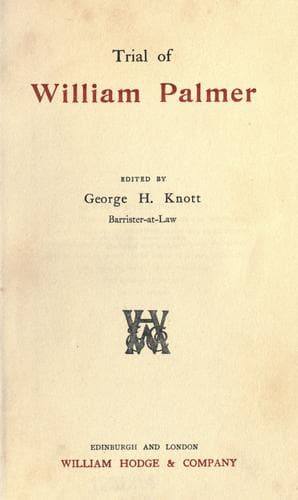
Cook, John Parsons, -1855; Palmer, William, 1824-1856 -- Trials, litigation, etc.; Trials (Murder) -- England -- London
WILLIAM VERNON STEVENS, examined by the ATTORNEY-GENERAL--I am a retired
merchant living in the city. I am the step-father of John Parsons Cook,
having married his father’s widow eighteen years ago. He did not live
with me, but we were always on friendly terms. He became entitled to
property worth about £12,000. The last time I saw him alive was at
Euston station at two o’clock on the afternoon of 5th November. He
looked better than I had seen him for some time, and I said, “My boy,
you look very well; you do not look anything of an invalid now.” He
struck himself firmly on the chest and said he was quite well. The next
time I saw him was after his death, information of which I received from
Mr. Jones, who came to my house on the Wednesday. I went to Lutterworth
on the Thursday to search for a will and any papers he had left. I found
a will. When I reached Rugeley the next day I went to the Talbot Arms,
and met Palmer in the passage. I had only seen him once before. Mr.
Jones introduced us in the inn, and we then went up and viewed the
body. I was greatly struck by the appearance of the countenance, the
tightness of the muscles across the face. We all then went down to one
of the sitting rooms, and I said to the prisoner that I understood from
Mr. Jones he knew something of my son’s affairs. He replied, “Yes, there
are £4000 worth of bills out of his, and I am sorry to say my name is to
them; but I have got a paper drawn up by a lawyer, signed by Mr. Cook,
to show that I have never had any benefit from them.” I told him I
feared there would be no money to pay them, and asked if he had no
horses or property. He replied that he had horses, but they were
mortgaged. He mentioned one debt of £300 that was owing to Cook. It had
nothing to do with sporting matters, and was a personal debt from a
relative of his. I then turned round to Palmer and said that, whether
Cook had left anything or not, he must be buried. Palmer immediately
said, “Oh! I will bury him myself if that is all.” I replied I could not
hear of that. Cook’s brother-in-law was there at the time, and he also
expressed a wish to bury him. I said it was my business, as executor, to
bury him, and that I intended to bury him in London in his mother’s
grave, and that the body would have to be at the inn for a day or two.
Palmer said that would be of no consequence so long as the body was
fastened up at once. Some short time afterwards I asked Palmer for the
name of some respectable undertaker in Rugeley, so that I might order a
coffin at once. He replied, “I have been and chosen that. I have ordered
a shell and a strong oak coffin.” I expressed my surprise, and said he
had no authority to do so. At my invitation, my son-in-law, Mr. Jones,
and Palmer all dined with me at the inn. We dined about three, as I was
going back to London by the quarter-past four train. Before I left I
asked Mr. Jones to go upstairs and bring me Cook’s betting book and any
papers.
Public-domain text, read in full here on John Shaqi.
Reviews
Reviews
No reviews yet
Be the first to share your thoughts on this work.
Join the Discussion
Join the discussion
Sign in to leave a comment or review.
Sign InorCreate an account