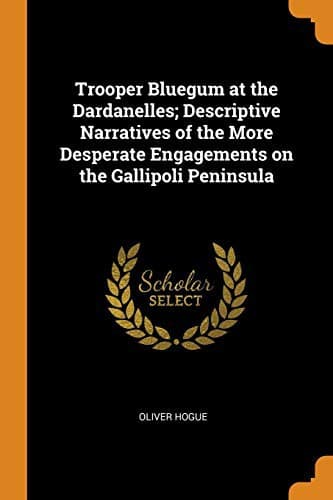
Trooper Bluegum at the Dardanelles: Descriptive Narratives of the More Desperate Engagements on the Gallipoli PeninsulaHogue, Oliver
History
Trooper Bluegum at the Dardanelles: Descriptive Narratives of the More Desperate Engagements on the Gallipoli Peninsula
Hogue, Oliver
World War, 1914-1918 -- Campaigns -- Turkey -- Gallipoli Peninsula; World War, 1914-1918 -- Personal narratives, Australian
"The public are hereby informed that the 700 British mitrailleuses
and 300 French cannon captured during the battle of Ari-Bournu at
Gallipoli by our heroic troops, in the course of bayonet charges in
which they drove into the sea and drowned more than twenty thousand
of the enemy, will be on exhibit in the foreign gallery of the Museum
immediately after the cessation of hostilities."
This startling item of information was so unexpected that it made
us all long to get to Constantinople to see the trophies of Turkish
prowess. It was solely with this object in view that we began making
fresh preparations for a special trip to that city beautiful.
CHAPTER XI
WAR VIGNETTES
AT ANZAC LANDING--SHRAPNEL VALLEY--THOSE WEIRD NAMES--MULES AND
DONKEYS--SPLENDOURS OF AN ANZAC NIGHT--OUR GREAT GUNS AND OUR
GUNNERS--VISIONS OF HUNTER RIVER AND WILLIAMS RIVER SCENES.
Vignettes of battle!
These are the kaleidoscopic pictures that remain mirrored in the
memory. I have forgotten what the transports looked like when we
reached Gallipoli. I only half remember the panorama of battle when
we first tackled the Turk. Yet there is no forgetting these little
snapshots of soldiering, the vivid vignettes which stand out in
clear-cut silhouette against the background of our experiences. Somehow
they seem more like tableaux vivants than a moving picture show.
Certainly the impression is not blurred by action, so the mind, like a
camera plate, retains the scene down to the minutest details. Perhaps,
when we think of the big things that our lads have done, these little
visions may seem hardly worth chronicling. But the Censor will not let
me take photographs, and after all it might interest the old folks
at home to scan these hurried lines and construct their own mental
pictures of the rugged and inhospitable Gallipoli Peninsula where so
many young Australians have fought and died for empire.
First, the Cove! It was in Anzac Cove we first landed. In spite of
the shrapnel shells which burst on the beach or plunged into the sea,
we could take stock of the whole scene before us--afloat and ashore.
Straight ahead the hills rose almost from the water's edge to a height
of 400 feet. To right and left were the army stores: little mountains
of bully beef and biscuits. Scores of soldiers moved hither and thither
on fatigue duty, giving Anzac the appearance of a thriving port. At
least five hundred men were swimming in the Cove entirely indifferent
to the enemy's shells. Under the sheltering shadow of the hill was
the field ambulance--doctors working overtime, orderlies running here
and there, stretcher-bearers coming and going with their burdens of
wounded and dead; seaward, transports lolled lazily on the placid
bosom of the Mediterranean; torpedo boats streaked about looking for
submarines; warships wreathed in battle-smoke belched broadsides;
aloft, a circling aeroplane.
Public-domain text, read in full here on John Shaqi.
Reviews
Reviews
No reviews yet
Be the first to share your thoughts on this work.
Join the Discussion
Join the discussion
Sign in to leave a comment or review.
Sign InorCreate an account