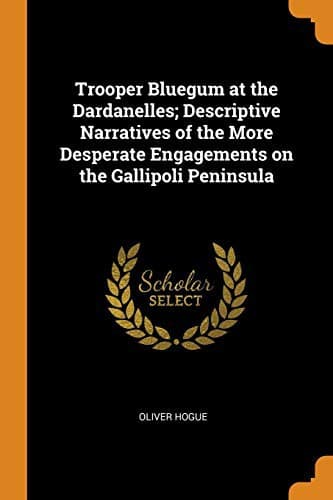
Trooper Bluegum at the Dardanelles: Descriptive Narratives of the More Desperate Engagements on the Gallipoli PeninsulaHogue, Oliver
History
Trooper Bluegum at the Dardanelles: Descriptive Narratives of the More Desperate Engagements on the Gallipoli Peninsula
Hogue, Oliver
World War, 1914-1918 -- Campaigns -- Turkey -- Gallipoli Peninsula; World War, 1914-1918 -- Personal narratives, Australian
We were given meat and vegetables and biscuits and cheese and jam. If
only we could have had a lump of bread for a change! For the biscuits
were so hard that they could be used to defend the trenches, if
necessary--either as missiles or as overhead cover. Colonel ---- broke
one of his teeth on one. So we tried to soak them in our tea. Then we
made them into porridge.
There was fighting on land and sea, in the air and under the water.
Aeroplane reconnaissance was a daily spectacle. Our airmen would go
aloft and have a good look at the enemy's position. The enemy's guns
would boom out all the time, and shrapnel shells would burst all round
the 'plane without ever seeming to hit it. We thought it was great
sport watching the white puffs of smoke where the shells burst. Then
the aeroplanes would drop bombs on the Turks for spite--"throw-downs"
we called them. Sometimes the position was reversed, and the Germans
dropped bombs on us. Two can play at the same game in war. Take the
hand grenades. You should have seen Corporal Renwick take them! Before
he became a soldier Renwick was well known on the cricket field--as
indeed were hundreds of others--and on Gallipoli he used to catch the
bombs and throw them back before they exploded. Nor was he the only one
who did this. It was like tossing live coals back and forth--playing
with fire. Some of our boys used to say it was the best "slip practice"
they ever had! Sometimes a bomb would explode prematurely and a man's
fingers would be blown off, and worse than that. But the others went on
with the game.
And we went swimming down at the beach, just as if it had been Manly
or Coogee. Only it was more exciting: Shells took the place of sharks.
Instead of the sudden cry one would sometimes hear at Manly or Coogee
of "'Ware shark," it was "'Ware shell!" The Turks are not the surfers
that the Australians are. They had little sympathy with such healthy
exercise, and they showed their disapproval of it by opening fire on
the beach; and then there was a warning whistle, and we all rushed in
to shelter. Afterwards we had the pleasure of initiating some Turkish
prisoners into the joys of surf-bathing, but the majority of them did
not take kindly to it.
And all the time the fighting went on. One night we had a great set-to.
The Turks mined one of our trenches and rushed in and captured it. This
was the affair at "Quinn's Post." We counter-attacked and re-took the
trench, killed and captured some of the Turks, and then took one of
their trenches. Then the hand grenades began to come, and the cricket
commenced. It was an exciting match. The Turks made a determined
attempt to recapture the position. They charged in strong force, but
our chaps all along the line "hit them to leg." We enfiladed them with
rifle and machine-gun fire, and they were eventually repulsed with a
loss of about 2,000.
Public-domain text, read in full here on John Shaqi.
Reviews
Reviews
No reviews yet
Be the first to share your thoughts on this work.
Elsewhere in the archive
Join the Discussion
Join the discussion
Sign in to leave a comment or review.
Sign InorCreate an account