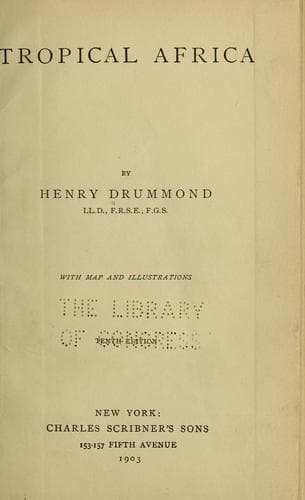
Africa, Central -- Description and travel; Africa, East -- Description and travel; Natural history -- Africa; Slave trade
Now as this agricultural function can never be dispensed with, it is
more than probable that nature will have there commissioned some
other animal to undertake the task. And there are several other
animals to whom this difficult and laborious duty might be entrusted.
There is the mole, for instance, with its wonderful spade-like feet,
that natural navvy, who shovels the soil about so vigorously, at
home; but against the burnt crust of the tropics even this most
determined of burrowers would surely turn the edge of his nails. The
same remark applies to those curious little geologists the marmots
and skipmunks, which one sees throwing up their tiny heaps of sand
and gravel on the American prairies. And though the torrid zone
boasts of a strong-limbed and almost steel-shod creature, the
ant-bear, his ravages are limited to the destruction of the nests of
ants; and however much this somewhat scarce animal contributes to the
result, we must look in another direction for the true tropical
analogue of the worm.
The animal we are in search of, and which I venture to think equal to
all the necessities of the case, is the termite or white ant. It is
a small insect, with a bloated, yellowish-white body, and a somewhat
large thorax, oblong-shaped, and colored a disagreeable oily brown.
The flabby, tallow-like body makes this insect sufficiently
repulsive, but it is for quite another reason that the white ant is
the worst abused of all living vermin in warm countries. The termite
lives almost exclusively upon wood; and the moment a tree is cut or a
log sawn for any economical purpose, this insect is upon its track.
One may never see the insect, possibly, in the flesh, for it lives
underground; but its ravages confront one at every turn. You build
your house, perhaps, and for a few months fancy you have pitched upon
the one solitary site in the country where there are no white ants.
But one day suddenly the door-post totters, and lintel and rafters
come down together with a crash. You look at a section of the
wrecked limbers, and discover that the whole inside is eaten clean
away. The apparently solid logs of which the rest of the house is
built are now mere cylinders of bark, and through the thickest of
them you could push your little finger. Furniture, tables, chairs,
chests of drawers, everything made of wood, is inevitably attacked,
and in a single night a strong trunk is often riddled through and
through, and turned into matchwood. There is no limit, in fact, to
the depredation by these insects, and they will eat books, or
leather, or cloth, or anything; and in many parts of Africa I believe
if a man lay down to sleep with a wooden leg it would be a heap of
sawdust in the morning. So much feared is this insect now, that no
one in certain parts of India and Africa ever attempts to travel with
such a thing as a wooden trunk. On the Tanganyika plateau I have
camped on ground which was as hard as adamant, and as innocent of
Public-domain text, read in full here on John Shaqi.
Reviews
Reviews
No reviews yet
Be the first to share your thoughts on this work.
Join the Discussion
Join the discussion
Sign in to leave a comment or review.
Sign InorCreate an account