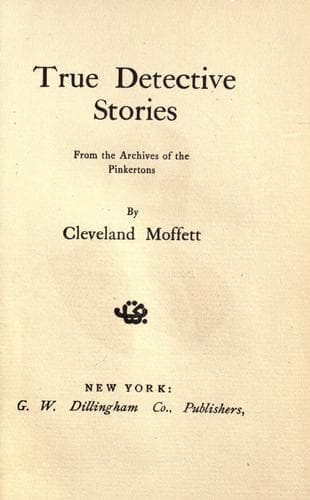
True Detective Stories from the Archives of the PinkertonsMoffett, Cleveland
History
True Detective Stories from the Archives of the Pinkertons
Moffett, Cleveland
Crime -- United States; Criminals -- United States; Detective and mystery stories, American
The method of locating a criminal in a great city is as interesting as
it is little understood. The first step is to secure from the local
police information as to the favorite haunts of criminals of the class
under pursuit, paying special regard in the preliminary inquiries to
the possibility of love-affairs; for thieves, even more than honest
men, are swayed in their lives by the tender passion, and are often
brought to justice through the agency of women. With so much of such
information in their possession as they could gather, Mr. Stone and
his detectives spent their time in likely resorts, picking up
acquaintance with frequenters, and, whenever possible, turning the
talk adroitly upon the man they were looking for. It is a mistake to
suppose that in work like this detectives disguise themselves. False
beards and mustaches, goggles and lightning changes of clothing, are
never heard of except in the pages of badly informed story-writers. In
his experience of over twenty-five years Mr. Murray never wore such a
disguise, nor knew of any reputable detective who did. In this
expedition the detectives simply assumed the characters and general
style of the persons they were thrown with, passing for men of
sporting tastes from the East; and, having satisfied the people they
met that they meant no harm, they had no difficulty in obtaining such
news of McCoy and the others as there was. Unfortunately, this was
not much.
After going from one city to another on various clues, hearing of one
member of the gang here and another there, and in each instance losing
their man, the detectives finally brought up in New Orleans. They had
spent five or six weeks of time and a large amount of money, only to
find themselves absolutely without a clue as to the whereabouts of the
men they were pursuing. They were much discouraged when a telegram
from Mr. Pinkerton told them that "Butch" McCoy was back in Galesburg,
where they had first sought him. Proceeding thither with all despatch,
they traced McCoy into a saloon, and there three of them,--John Smith,
representing the Rock Island Railroad; John McGinn, for the Pinkerton
Agency; and Frank Murray, working for Mr. Stone,--with drawn
revolvers, captured him, in spite of a desperate dash he made to
escape.
McCoy's capture was the occasion of much felicitation among the people
interested in the matter. Mr. St. John and Mr. Stone were confident
that now the whole mystery of the express robbery could be solved and
the murderer convicted. But McCoy showed on trial that he had left New
Orleans to come North only the night before the murder and had spent
the whole of that night on the Illinois Central Railroad. It also
appeared that McCoy's associate, Connors, was in jail at the time of
the robbery, and that the man "Jeff" was dead. Thus the whole Plunkett
story was exploded.
III
Public-domain text, read in full here on John Shaqi.
Reviews
Reviews
No reviews yet
Be the first to share your thoughts on this work.
Join the Discussion
Join the discussion
Sign in to leave a comment or review.
Sign InorCreate an account