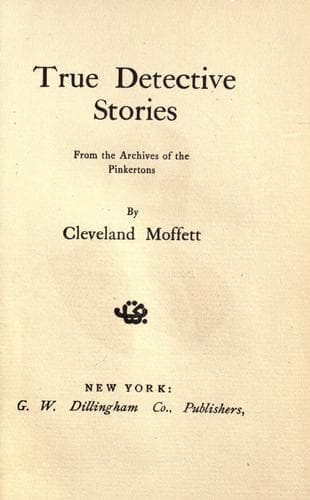
True Detective Stories from the Archives of the PinkertonsMoffett, Cleveland
History
True Detective Stories from the Archives of the Pinkertons
Moffett, Cleveland
Crime -- United States; Criminals -- United States; Detective and mystery stories, American
Meantime Watt had been arrested in Chicago, also charged with murder,
and in several examinations had shown signs of breaking down and
confessing, but in each instance had recovered himself and said
nothing. The evidence of Schwartz himself, however, in the interview
at the jail, taken with the mass of other evidence that had
accumulated, was sufficient to secure the conviction of both men, who
were condemned at the trial to life-imprisonment in the Joliet
penitentiary. They would undoubtedly have been hanged but for the
conscientious scruples of one juryman, who did not believe in capital
punishment. Watt has since died, but Schwartz, at last accounts, was
still in prison.
About a year after the trial Schwartz's Chicago wife died of
consumption. On her death-bed she made a full confession. She said
that her husband's mind had been inflamed by the constant reading of
sensational literature of the dime-novel order; and that under this
evil influence he had planned the robbery, believing that it would be
easy to intimidate a weak little man like Nichols, and escape with the
money without harming him. Nichols, however, had fought like a tiger
up and down the car, and had finally forced them to kill him. In the
fight he had torn off the mask that Mrs. Schwartz had made out of one
of her husband's old coats. It was Watt who fired the pistol, while
Schwartz used the poker. Schwartz had given Watt five thousand dollars
of the stolen money, and had kept the rest himself. He had carried the
money away in an old satchel bought for the purpose. A most unusual
place of concealment had been chosen, and one where the money had
escaped discovery, although on several occasions, in searching the
house, the detectives had literally held it in their hands. Schwartz
had taken a quantity of the cartridges he bought for his shot-gun, and
emptying them, had put in each shell one of the fifty- or
one-hundred-dollar bills, upon which he had then loaded in the powder
and the shot in the usual way, so that the shells presented the
ordinary appearance as they lay in the drawer. The detectives had even
picked out some of the shot and powder in two or three of the shells;
but, finding them so like other cartridges, had never thought of
probing clear to the bottom of the shell for a crumpled-up bill.
Public-domain text, read in full here on John Shaqi.
Reviews
Reviews
No reviews yet
Be the first to share your thoughts on this work.
Elsewhere in the archive
Join the Discussion
Join the discussion
Sign in to leave a comment or review.
Sign InorCreate an account