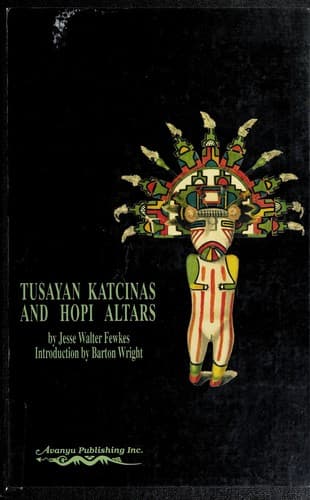
[32] The Katcinas, sometimes spelt Cachinas, are believed to be the
same as the Zuñi Kókos and possibly the Nahuatl teotls. The derivation
is obscure; possibly it is from kátci, spread out, horizontal, the
surface of the earth, náa, father, abbreviated na, surface of land,
father. The Tusayan Indians say that their Katcinas are the same as
the Zuñi Kóko, pronouncing the word as here spelled. Cushing insists,
however, that the proper name of the organization is Kâ′kâ. I find Mrs
Stevenson, in her valuable article on the Religious Life of a Zuñi
Child, has used the spelling Kok′ko, which introduces the o sound which
the Tusayan people distinctly use in speaking of the Katcinas of their
nearest Pueblo neighbors. This variation in spelling of one of the more
common words by conscientious observers shows one of the difficulties
which besets the path of those who attempt etymologic dissection of
Pueblo words. Many Zuñi words in the mouths of the Hopi suffer strange
modifications, so that I am not greatly surprised to find idiomatic
differences between the Hopi dialect of the East mesa and that of
Oraibi. How much may result after years of separation no one can tell,
but the linguist must be prepared to find these differences very
considerable.
[33] This person is said to have been the mother of the Katcinas. She
also was the mother of the monsters, the slaughter of whom by the
cultus hero, Pü′ükoñhoya, and his twin brother is a constant theme in
Tusayan folklore.
[34] Stevenson, Navaho Sand Paintings, in Eighth Annual Report of the
Bureau of Ethnology.
[35] Journal of American Ethnology and Archæology, vol. II, No. 1.
[36] The Hopi report that the Zuñi believe that the dead are changed
into Katcinas and go to a Sípapû, which they descend and tell the
“chiefs” to send the rain. The Hopi believe that the dead become
divinized (Katcinas in a loose meaning) and intercede for rain. (See
discussion of Mrs Stevenson’s statement that the dead send rain.) It
seems to me that students of primitive myth and ritual have hardly
begun to realize the important part which orientation plays in early
religions. As research progresses it will be found to be of primary
importance. The idea of world-quarter deities sprang from astronomical
conceptions and was derived from a primitive sun worship in which the
lesser deities naturally came to be associated with the four horizon
points of solstitial sunrise and sunset.
Public-domain text, read in full here on John Shaqi.
Reviews
Reviews
No reviews yet
Be the first to share your thoughts on this work.
Join the Discussion
Join the discussion
Sign in to leave a comment or review.
Sign InorCreate an account