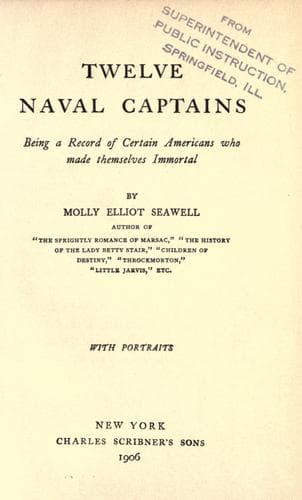
Twelve Naval Captains: Being a Record of Certain Americans Who Made Themselves ImmortalSeawell, Molly Elliot
History
Twelve Naval Captains: Being a Record of Certain Americans Who Made Themselves Immortal
Seawell, Molly Elliot
United States. Navy -- Biography
Captain Lambert lived several days after the fight, and was put ashore,
with the rest of the officers of the Java, at San Salvador. Commodore
Bainbridge's wounds were dangerous, as he had remained on deck from
the time he was shot, at half past two in the day, until eleven
o'clock that night. When Captain Lambert was about to be taken ashore,
Bainbridge had himself carried on deck by two of his officers, to where
Captain Lambert lay in his cot. Bainbridge, who was then dangerously
ill and in great pain, returned the dying officer his sword, and
Captain Lambert, still conscious, feebly thanked him. The interview
brought tears to the eyes of all who witnessed it, and the two captains
parted, never to meet again in this world, with feelings of kindness
such as brave enemies should entertain for each other.
Bainbridge treated all of his prisoners with great generosity, and
they showed a very grateful appreciation of it. On the 4th of January,
on being informed by Lieutenant Chads, next in command, of Captain
Lambert's death, Bainbridge wrote a very beautiful letter, in which he
said: "Commodore Bainbridge takes this occasion to observe, in justice
to Lieutenant Chads, who fought the Java after Captain Lambert was
wounded, that he had done everything which a brave and skilful officer
could do, and further resistance would have been a wanton effusion of
human blood."
This was valuable testimony to Lieutenant Chads on his future court
martial. Bainbridge had known what it was to lose his ship, and he
could feel for an officer under a similar misfortune. So thoughtful
was his kindness to his prisoners, that General Hislop in gratitude
gave him a splendid gold-hilted sword, and the two remained friends
and correspondents during the rest of their lives. The conduct of
Bainbridge and his officers was duly reported in England, and the
Prince Regent, afterward George the Fourth, who could say graceful
things, remarked that he would like to shake hands with Bainbridge,
for his magnanimity to the British prisoners. The loss of the Java,
following upon that of the Guerrière and the Macedonian, produced a
shock of pain and grief throughout Great Britain. The venerable Admiral
Jarvis, the day after the news reached London, said he had passed a
sleepless night, not from the destruction of a single British frigate,
but because of the seamanlike manner in which it had been captured,
which gave him as an Englishman much uneasiness and apprehension of the
future naval greatness of the United States. Bainbridge returned to
the United States within five months of leaving home, and was welcomed
as victorious captains always are. He landed at Boston, where he was
given a splendid public dinner; resolutions of thanks from the city
and State governments were passed in his honor, and he and the brave
fellows under him became the heroes of the hour. Amid all this popular
adoration, Bainbridge did not forget the claims of the seamen, and
Public-domain text, read in full here on John Shaqi.
Reviews
Reviews
No reviews yet
Be the first to share your thoughts on this work.
Join the Discussion
Join the discussion
Sign in to leave a comment or review.
Sign InorCreate an account