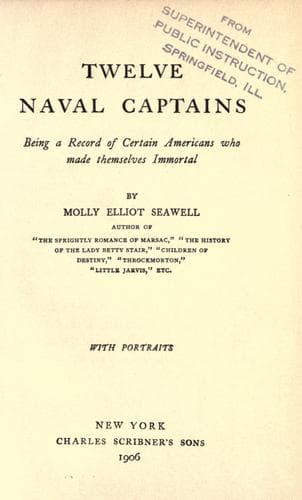
Twelve Naval Captains: Being a Record of Certain Americans Who Made Themselves ImmortalSeawell, Molly Elliot
History
Twelve Naval Captains: Being a Record of Certain Americans Who Made Themselves Immortal
Seawell, Molly Elliot
United States. Navy -- Biography
immediately began efforts to get them prize money. He wrote, with much
justice, that the captain usually got all the honor when a ship was
captured, while the officers and men, who did quite as much toward
success, got nothing, except from the generosity of the government;
and he was deeply gratified when Congress, after awarding him the
customary gold medal, and the officers silver medals, gave the crew a
substantial sum in prize money. He gave up the Constitution to Captain
Stewart, who, like Hull and himself, was destined to do great things in
her.
Bainbridge did not get to sea again during the war, but soon after
the peace he went to the Mediterranean in command of a splendid
squadron destined to punish the Dey of Algiers for certain treacherous
acts toward American vessels. Bainbridge hoisted his flag on the
Independence, seventy-four guns,--the first line-of-battle ship over
which the American flag ever floated. Decatur, who had sailed in
advance of the commander-in-chief, had already brought the Dey to terms
before Bainbridge arrived, but it was thought well to show the squadron
for some time in European waters. It consisted of the largest naval
force that had, up to that time, ever been collected under an American
flag officer. It consisted of one ship of the line, three splendid
frigates, and fourteen smaller vessels, all well officered and manned,
and fine ships of their class. At Gibraltar, where it lay some time,
it was extremely admired, and the American officers received much
attention from the officers of the British fleet and garrison.
In 1820 Bainbridge again took a noble fleet to the Mediterranean. On
reaching Gibraltar, he found a very bad state of affairs between the
officers of the American squadron, which rendezvoused there, and
the British officers of the garrison and fleet. Misunderstandings,
quarrels, and duels were so frequent that the Governor had taken
upon himself to forbid the American officers from visiting the town
or garrison. He expressed to Commodore Bainbridge, however, a desire
for an amicable arrangement. Bainbridge at once required that this
prohibition be removed, and refused to treat until it was withdrawn,
which was done. As the British officers had very great personal regard
for Bainbridge, he was the man for smoothing down differences while
maintaining the dignity of an American officer. From that day, American
officers have been well treated at Gibraltar. This was Bainbridge's
last cruise, and afterward his service was in command of different navy
yards. It is said that in the course of his naval career he moved his
family twenty-six times. His health began to fail after his fifty-fifth
year, but he survived his sixtieth year. He died at Philadelphia in
July, 1833, honored and admired to an extraordinary degree. His last
words were, as he raised himself from his bed of death,--
"Give me my sword! And call all hands to board the enemy!"
EDWARD PREBLE
Public-domain text, read in full here on John Shaqi.
Reviews
Reviews
No reviews yet
Be the first to share your thoughts on this work.
Join the Discussion
Join the discussion
Sign in to leave a comment or review.
Sign InorCreate an account