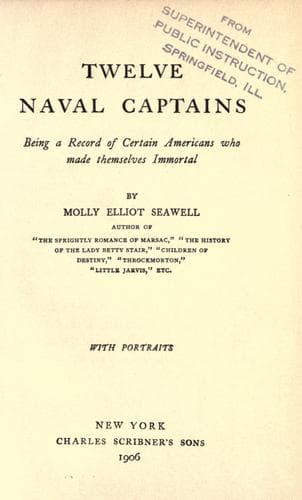
Twelve Naval Captains: Being a Record of Certain Americans Who Made Themselves Immortal — John Shaqi
Twelve Naval Captains: Being a Record of Certain Americans Who Made Themselves ImmortalSeawell, Molly Elliot
History
Twelve Naval Captains: Being a Record of Certain Americans Who Made Themselves Immortal
Seawell, Molly Elliot
United States. Navy -- Biography
The story of Commodore Preble is, in itself, not only exciting but
amusing; and the gravest histories of him have not been able to keep
the vagaries of the commodore's celebrated bad temper in abeyance.
Preble was, unquestionably, one of the very greatest sea officers this
country ever produced; and however ridiculous the outbursts of his
fiery temper might make him, they never made him contemptible. "The
old man has the best heart, if he has the worst temper, in the world,"
was always said of him by the junior officers who were the victims of
his wrath. Preble seems to have come naturally by his impetuosity. His
father before him, General Preble, brigadier in the provincial army,
was one of the same sort, and it was commonly said by their neighbors
and friends that "Ned has a good deal of the brigadier in him." The
father and son were deeply attached to each other, although they often
came in conflict. The last time was when Edward was about sixteen years
old, in 1777. Men were so scarce, owing to most of them having enlisted
in the continental army, that the old brigadier set his boys to hoeing
potatoes on his farm near Portland, Maine. Edward had not worked very
long when, throwing away his hoe, he declared he had no taste for such
work, and walked himself off to the seacoast, where he entered the
first vessel that would take him. The brigadier did not seem to regard
this as wholly unjustifiable, and, seeing the boy was bent on the sea,
got him a midshipman's commission in the infant navy of the colonies.
In almost his first engagement Edward was taken prisoner, but was given
his parole at New York. There is in existence a letter written to him
at that time by his father the brigadier, which shows great affection
for the boy, and the strongest possible desire that he should conduct
himself honorably. The old man, then over seventy, reminds his son "not
to stain his honor by attempting to escape." And another recommendation
is followed by the utterance of a great truth which it would be well
if every human being acted upon. It is this: "Be kind and obliging to
all; _for no man ever does a designed injury to another without doing a
greater to himself_."
[Illustration: Edward Preble]
Before this, an event had occurred which Preble occasionally alluded to
in after life, and which, marvellous as it seems, must be accepted as
true, for Preble was too close an observer to have been deceived, and
too sensible a man to have assumed that he saw a thing which he did not
really see.
Public-domain text, read in full here on John Shaqi.
Reviews
Reviews
No reviews yet
Be the first to share your thoughts on this work.
Join the Discussion
Join the discussion
Sign in to leave a comment or review.
Sign InorCreate an account