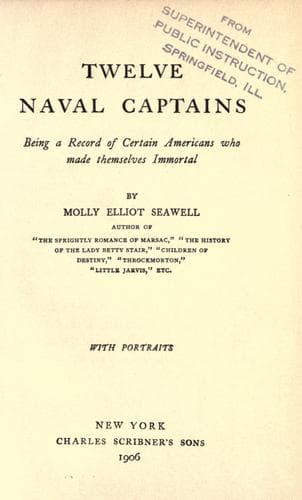
Twelve Naval Captains: Being a Record of Certain Americans Who Made Themselves ImmortalSeawell, Molly Elliot
History
Twelve Naval Captains: Being a Record of Certain Americans Who Made Themselves Immortal
Seawell, Molly Elliot
United States. Navy -- Biography
A year afterward, when the "parcel of schoolboys" had covered
themselves with glory, Colonel Lear asked the commodore if he
remembered this speech.
"Perfectly," answered the commodore. "But they turned out to be good
schoolboys."
After collecting his squadron at Gibraltar, Preble, with three vessels,
stood for Tangier. The Emperor of Morocco pretended to be very friendly
with the Americans, and sent them presents of bullocks, sheep, and
vegetables; but Preble, while treating him with respect, yet kept
his ships cleared for action and the men at quarters day and night,
lest the Moors should show treachery. On going ashore with some of
his officers to pay a visit of ceremony to the Emperor, he gave a
characteristic order to the commanding officer of the ship: "If I do
not return, enter into no treaty or negotiation for me, but open fire
at once." On reaching the palace he was told that the party must leave
their side-arms outside before entering the Emperor's presence. Preble
replied firmly that it was not the custom of the American navy, and
that they should enter as they were,--which they did. The Emperor soon
found what sort of a man he had to deal with, and Preble had no further
trouble with him. A few weeks after the arrival of the squadron, Preble
heard the news of the loss of the Philadelphia. Nothing better shows
the steadfast and generous nature of the man than the manner in which
he accepted this misfortune. No regrets were heard from him; no railing
accusations against Bainbridge; but a prompt and determined grappling
with the terrible complication of having a great part of his force
turned against him; and the most tender consideration for the feelings
as well as the rights of Bainbridge and his men.
Preble was enabled to provide himself with bomb-vessels and gunboats
by the aid of the King of Naples, who, like all the other European
sovereigns, wished to see the nest of pirates exterminated. The first
one of the "schoolboys" to distinguish himself was Decatur,[8] who, in
February, 1804, crept by night into the harbor of Tripoli, and earned
immortality by destroying the Philadelphia as she swung to her anchors,
in the face of one hundred and nineteen great guns and nineteen vessels
which surrounded her. The destruction of the Philadelphia not only
wiped away the stain of losing her, in the first instance, but was
of the greatest advantage to Commodore Preble in the bombardment of
Tripoli, as the frigate would have been a formidable addition to the
defence of the town.
Public-domain text, read in full here on John Shaqi.
Reviews
Reviews
No reviews yet
Be the first to share your thoughts on this work.
Elsewhere in the archive
Join the Discussion
Join the discussion
Sign in to leave a comment or review.
Sign InorCreate an account