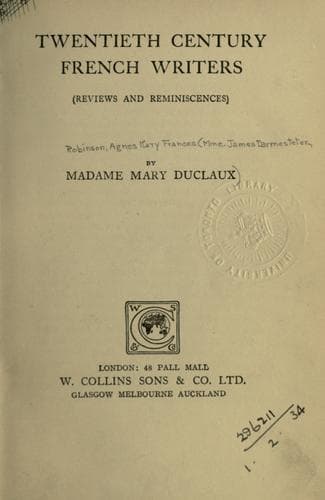
Twentieth Century French Writers: Reviews and Reminiscences — John Shaqi
Twentieth Century French Writers: Reviews and ReminiscencesRobinson, A. Mary F. (Agnes Mary Frances)
History
Twentieth Century French Writers: Reviews and Reminiscences
Robinson, A. Mary F. (Agnes Mary Frances)
French literature -- 20th century -- History and criticism
They live no less than us in the middle of immensities, only, from
their lower standpoint, they remark (even less than we do) the
disproportion between the world they inhabit, and the unthinkable
Infinity they leave unmodified.
‘Très peu de ciel dans ce décor; c’est important de donner
l’impression qu’étant très bas, à hauteur de poule, on en voit
moins.’
Knowing so little about it, Chantecler is convinced that the magic of
his cock-a-doodle-doo! makes the sun rise every morning! The pearl of
the poem is the scene in the second act, where Chantecler confides
this marvellous secret to the _gloriosa donna delta sua mente_, the
Hen-Pheasant, who has taken refuge in the poultry-yard. A pheasant sees
more of the world than a cock, flies and rockets up in the sky, dwells
in the forest, and therefore, half-sceptical, half-scandalised, she
listens while Chantecler, manlike, expatiates on the necessity of his
existence.
So far at least the myth is charming in its quaint philosophy, the
characters appear full of humour each of them as French as French
can be; for why should not animals as well as human beings, have
a nationality and racial qualities of their own? Chantecler is a
coxcombed Don Quixote, chimerical, infatuate, peremptory, and brave;
but he is, we have said, a _French_ Don Quixote, and so he represents
not only chivalry, but also order and authority; he is not only
generous but masterful; loyal to his subordinates, vain of his beauty
and prone to vaunt it; and he thinks himself the natural sultan of
every female fowl. Chantecler, like Don Quixote, is absurd; and yet
not merely lovable, but honourable in his absurdity. If his adventure
proves anything, it is that an illusion and a chimera are necessary to
prevent us from lapsing into scepticism or savagery.
Chantecler, with his valiance, his vain-glory, and his optimism, is
one type of French character (a noble or military sort of type);
another French fowl is the blackbird, the ‘Merle.’ Le Merle is a French
Mephistopheles--a _Geist der stets verneinet_--paralysing all effort
by his scepticism, his criticism, his pitiless raillery, his pitiable
_blague_, which is often merely,--
‘Une prudence, un art de rester vague,
Un élégant moyen de n’avoir pas d’avis.’
He is
‘Le petit croque-mort de la Foi.’
The blackbird is at once a _boulevardier_ and an _intellectuel_. He
is the ‘Chat Noir,’ he is Montmartre; alas, he is the pretext for many
bad verses, execrable conceits, and parlous puns. Not that a poet, I
repeat, is obliged to have good taste; but there are moments when the
pun kills the poem. When the Blackbird says to the philosophic fowl,
‘Fichez le Kant!’ (camp); when he interrupts, ‘C’est vieux œufs!’
(vieux jeu)--surely he outdistances the most trivial dialogues of Moth
and Armado; and we answer with old Chaucer,--
‘Allas! conceytes stronge!’
and exclaim with Shakespeare’s Troilus,--
Public-domain text, read in full here on John Shaqi.
Reviews
Reviews
No reviews yet
Be the first to share your thoughts on this work.
Join the Discussion
Join the discussion
Sign in to leave a comment or review.
Sign InorCreate an account