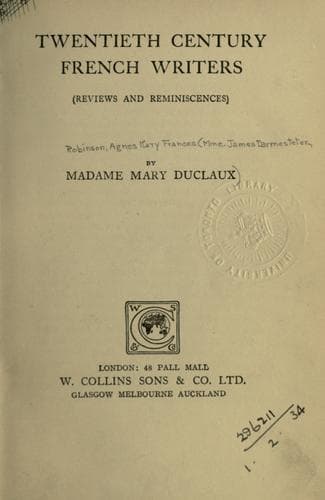
Twentieth Century French Writers: Reviews and ReminiscencesRobinson, A. Mary F. (Agnes Mary Frances)
History
Twentieth Century French Writers: Reviews and Reminiscences
Robinson, A. Mary F. (Agnes Mary Frances)
French literature -- 20th century -- History and criticism
The Cock’s Hymn to the Sun is so devoid of all our cosmic ideas that
I have heard more than one critic deride it on this account; but how
wise, how truly a seer, is the poet in showing the wonder of the sun as
it appears to an animal who sees no further than the almond trees at
the end of the valley! The Infinite is the Infinite, though we look at
it through a keyhole, and to an animal or an infant the sun is still
the sun. The poet has chosen just those aspects and effects which may
appeal to a mind deprived of reason no less than to ourselves. The
sun dries the dew from the grass, and lends a grace even to the faded
almond flowers; the sun shining on a pane of glass or the soapy water
in a tub makes of them a glory; the sun turns the sunflower westward
in his course, and makes the tin cock on the church tower a dazzling
chanticleer; the sun shining through the boughs of the lime-walk sheds
on the gravel trembling pools of light which wobble so lovely that one
scarcely dares to walk there; the sun makes a banner of the clout that
dries on the hedge; and gilds with a wonderful lustre the varnished
earthenware crock in the farm-yard; thanks to the sun the hayrick has
gold on his hat and the hive has gold on her hood:--
‘Gloire à toi sur les prés! Gloire à toi dans les vignes!
Sois béni parmi l’herbe et contre les portails!
Dans les yeux des lézards et sur l’aile des cygnes!
Ô toi qui fais les grandes lignes
Et qui fais les petits détails!
‘C’est toi qui, découpant la sœur jumelle et sombre
Qui se couche et s’allonge au pied de ce qui luit,
De tout ce qui nous charme as tu doubler le nombre,
À chaque objet donnant une ombre
Souvent plus charmante qui lui!
‘Je t’adore, Soleil! Tu mets dans l’air des roses,
Des flammes dans la source, un dieu dans le buisson!
Tu prends un arbre obscur et tu l’apothéoses!
Ô Soleil! toi sans qui les choses
Ne seraient que ce qu’elles sont!’
In this beautiful ode, Edmond Rostand really enriched French literature
with an image of the greatest thing in the universe as it may appear to
the humblest living being; and, despite here and there an ugly, trivial
turn of phrase (we shudder at _tu l’apothéoses_), despite the hard,
happy-go-lucky lilt of the verse, its simplicity is full of a natural
magic.
No less than man, just as naturally, and (owing to his more limited
imagination) even more fervently, Chantecler considers himself the
centre of the universe. In a recent letter to Jean Coquelin about the
scene-painting and staging of his play Rostand has put his point of
view:--
‘L’idée de mon décor est ceci: donner la sensation qu’une petite
allée de jardin est, pour les volailles, une voie immense, une Via
Appia.’
Public-domain text, read in full here on John Shaqi.
Reviews
Reviews
No reviews yet
Be the first to share your thoughts on this work.
Join the Discussion
Join the discussion
Sign in to leave a comment or review.
Sign InorCreate an account