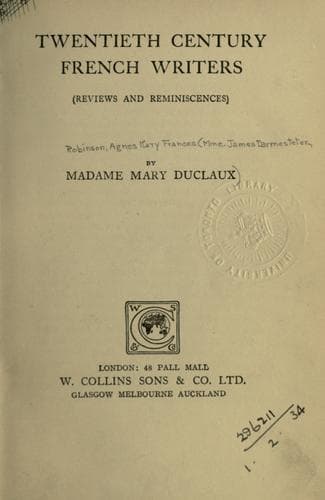
Twentieth Century French Writers: Reviews and ReminiscencesRobinson, A. Mary F. (Agnes Mary Frances)
History
Twentieth Century French Writers: Reviews and Reminiscences
Robinson, A. Mary F. (Agnes Mary Frances)
French literature -- 20th century -- History and criticism
It is not easy to account for the enthusiasm aroused in France, among
the younger writers, by the works of Paul Claudel, unless we accept
the explanation that, with all his faults, he is a great poet. He is
a difficult author, often wilfully obscure and allusive; his dramas
are lyrical symbols rather than plays and, whatever he write, ode or
tragedy, he uses the same medium, a sort of rhythmical prose, sometimes
like Walt Whitman’s dithyrambs, and sometimes like the Psalms.
Nothing is less familiar, less lifelike, more hieratic, than the manner
of Claudel. In every detail of his art he innovates and experiments:
style, language, conception, even the very names of his characters bear
witness to a restless personality, starting off on a quest of his own,
continuing no other writer, impatient of yoke or path. And though he
lose himself and stumble in his search for an Ideal, be sure he will
never turn back, never take the highroad, but just go on persistently,
making a rule and a guide for himself out of the exigencies of his own
peculiar temperament and creating a doctrine out of his fantasies.
He is often absurd, violent, rhetorical, extravagant; his plays are
frequently no more than psychological dialogues between the dissociated
elements of his own personality. At other times he will suggest to
us a Pindar disguised in the mantle of Saint Thomas Aquinas. He is
often as unreal as Il Greco! And yet this incomplete and exasperating
poet is, in truth, a great artist (or at least has the makings of
one), and it is not out of pure perversity that a Francis Jammes has
compared him to Pascal, that others have called him _haut comme Dante_.
They exaggerate; but there is in them more understanding than in the
perplexed spectator of _L’Échange_ or _L’Otage_, who is persuaded that
M. Claudel only does it to annoy.
What is then the message that Paul Claudel is obscurely crying to his
generation, faltering like the prophet, ‘â, â, Domine, nescio loqui?’
Public-domain text, read in full here on John Shaqi.
Reviews
Reviews
No reviews yet
Be the first to share your thoughts on this work.
Join the Discussion
Join the discussion
Sign in to leave a comment or review.
Sign InorCreate an account