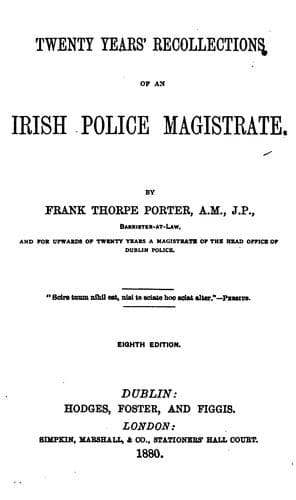
Twenty Years' Recollections of an Irish Police MagistratePorter, Frank Thorpe
History
Twenty Years' Recollections of an Irish Police Magistrate
Porter, Frank Thorpe
Crime -- Ireland; Criminals -- Ireland; Ireland -- Social life and customs; Porter, Frank Thorpe, 1801-1882
In 1831, during Earl Grey's administration, Sirr attended meetings
convened in favour of Parliamentary Reform, and moved resolutions of the
most liberal tendency. He voted at the city election for the Reform
candidates, and was twitted by the late Thomas Ellis for having deserted
his party and forgotten his principles. His answer was simple and
true--"I am totally unchanged; I have always supported _the Government_,
and I shall continue to do so."
When the piers which form Kingstown harbour were in course of
construction, the supply of stone was derived from immense quarries at
Killiney, and conveyed along a tramway, on which, near the quarries,
there were slopes, down which the loaded waggons required no impelling
power, but rather to be restrained, by breaks, from acquiring a
dangerous velocity. Major Sirr was fond of collecting natural
curiosities, especially of a geological nature; and he frequently
visited Killiney in quest of spar formations, which were occasionally
found there. He was by no means niggardly in his dealings with the spar
finders; but still he could not conciliate them into a feeling of
kindness or respect. One day he was proceeding up the tramway slope,
when the discharge of artillery at the Pigeon House fort attracted his
attention. He turned and looked in the direction of the firing, just at
the moment when a train of loaded wagons was about to descend. Being
right before them, he would have been utterly destroyed in a moment, but
the breaksman saw his perilous situation, and applied the requisite
pressure, stopped the train, and saved the Major. Several persons
witnessed his danger and the prompt means by which it was averted. On
the transaction becoming known in the quarries, there was an immediate
strike. All work was stopped, and a determination was unanimously avowed
to insist on the dismissal of the breaksman. No specific complaint was
preferred against the individual whose expulsion was required. The
Harbour Commissioners deputed Mr. Hickman Kearney to enquire into the
grounds and reasons for such an extraordinary demand. He went to the
quarries and called on the workmen to come forward and explain the cause
of their animosity to the breaksman. The only reply was that "he should
go." It appeared, on reference to the clerk of the works, and to the
overseers, that the obnoxious man was honest, sober, diligent, and
attentive to his duties; and it was strongly urged that no accident had
occurred at the slope since his appointment, and that he had, by his
presence of mind and promptitude, saved Major Sirr's life. This produced
a general exclamation of "That's the reason he shan't stay amongst us.
What business had he to save the Major?" The poor breaksman would have
lost his employment, but for an old and influential workman who
interfered in his favor, and induced the others to forgive him,
_provided he faithfully promised never to do the like again_.
Public-domain text, read in full here on John Shaqi.
Reviews
Reviews
No reviews yet
Be the first to share your thoughts on this work.
Join the Discussion
Join the discussion
Sign in to leave a comment or review.
Sign InorCreate an account