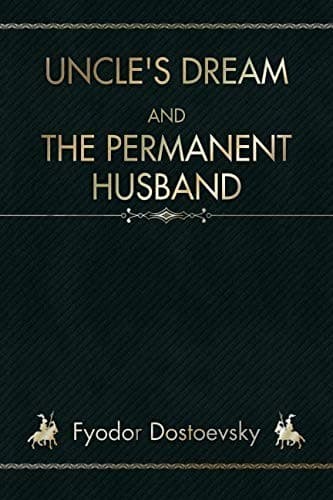
Uncle's Dream; and The Permanent HusbandDostoyevsky, Fyodor
General
Uncle's Dream; and The Permanent Husband
Dostoyevsky, Fyodor
Princes -- Russia -- Fiction; Russia -- Social life and customs -- 1533-1917 -- Fiction
“Ye—yes, ye—yes, Nap—oleon. We talked about philosophical subjects. And do
you know, my boy, I became quite sorry that the English had been so hard
upon him. Of course, though, if one didn’t chain him up, he would be
flying at people’s throats again! Still I’m sorry for him. Now I should
have managed him quite differently. I should have put him on an
uninhabited island.”
“Why uninhabited, uncle?” asked Mosgliakoff, absently.
“Well, well, an inhabited one, then; but the in—habitants must be good
sort of people. And I should arrange all sorts of amusements for him, at
the State’s charge: theatres, balle’s, and so on. And, of course, he
should walk about, under proper su—pervision. Then he should have tarts
(he liked tarts, you know), as many tarts as ever he pleased. I should
treat him like a fa—ather; and he would end by being sorry for his sins,
see if he wouldn’t!”
Mosgliakoff listened absently to all this senile gabble, and bit his nails
with impatience. He was anxious to turn the conversation on to the subject
of marriage. He did not know quite clearly why he wished to do so, but his
heart was boiling over with anger.
Suddenly the old man made an exclamation of surprise.
“Why, my dear boy, I declare I’ve forgotten to tell you about it. Fancy, I
made an offer of marriage to-day!”
“An offer of marriage, uncle?” cried Paul, brightening up.
“Why, ye—yes! an offer. Pachomief, are you going? All right! Away with
you! Ye—yes, _c’est une charmante personne_. But I confess, I took the
step rather rash—ly. I only begin to see that now. Dear me! dear, dear
me!”
“Excuse me, uncle; but _when_ did you make this offer?”
“Well, I admit I don’t know exactly _when_ I made it! Perhaps I
dre—dreamed it; I don’t know. Dear me, how very strange it all seems!”
Mosgliakoff trembled with joy: his new idea blazed forth in full developed
glory.
“And _whom_ did you propose to?” he asked impatiently.
“The daughter of the house, my boy; that beau—tiful girl. I—I forget what
they call her. Bu—but, my dear boy, you see I—I can’t possibly marry. What
am I to do?”
“Oh! of course, you are done for if you marry, that’s clear. But let me
ask you one more question, uncle. Are you perfectly certain that you
actually made her an offer of marriage?”
“Ye—yes, I’m sure of it; I—I——.”
“And what if you dreamed the whole thing, just as you did that you were
upset out of the carriage a second time?”
“Dear me! dear me! I—I really think I may have dreamed it; it’s very
awkward. I don’t know how to show myself there, now. H—how could I find
out, dear boy, for certain? Couldn’t I get to know by some outside way
whether I really did make her an offer of ma—arriage or not? Why, just you
think of my dreadful po—sition!”
“Do you know, uncle, I don’t think we need trouble ourselves to find out
at all.”
“Why, wh—what then?”
“I am convinced that you were dreaming.”
“I—I think so myself, too, my dear fellow; es—pecially as I often have
that sort of dream.”
Public-domain text, read in full here on John Shaqi.
Reviews
Reviews
No reviews yet
Be the first to share your thoughts on this work.
Elsewhere in the archive
Join the Discussion
Join the discussion
Sign in to leave a comment or review.
Sign InorCreate an account