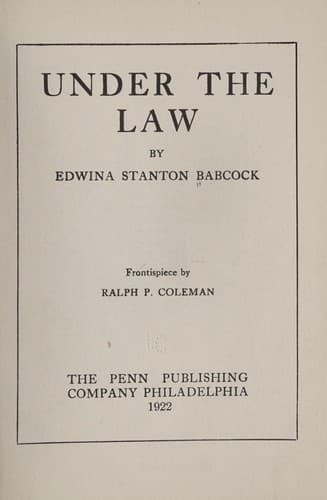
Amnesiacs -- Fiction; New York (State) -- Social life and customs -- Fiction; Trials -- Fiction; Young women -- Fiction
The other shook his head. "So do I," he said in a low tone, "but,"
he waved his hand to the street outside, "do you see much out there
that looks like new standards? It's the calendar motto still." For a
moment the two men stood in the window reading the street like a book
on which figures of men and women like words told the story of the
vicinity. Morris's mild, plainly-dressed women doing the morning's
marketing, face, features and walk betokening a certain niggardliness
with life; a complacent adjustment to the best that has been instead
of an insistence upon the best that shall be. Occasional handsome cars
holding peevish city faces come to the country for a great poison herb,
Novelty. Young people flitting about in droves driven by insatiability
and their peculiar disease, leisure and unapplied brains. One or two
old forms tottering in the sunshine, pleased, interested with little
trivial occurrences, yet powerful, holding the power of prestige.
The usual village types, the static parson, the elastic politician,
the loafers on the corner, the nameless village woman, the scoundrel
village man, the sanctimonious gossips, the schools at twelve pouring
out of their hoppers the little victims of all whatever good or ill
might be; up and down the streets, these forms, symbols of life, moved
and went about their business. But no matter what they spelled in
between they wrote irrevocably on the pavements, Greed, and also Fear,
and Popularity. They did not write Progress.
Watts, his dark face turned on the others, looked inquiringly. "The
same as Athens under Pericles, I suppose?" he questioned. "The great
souls come and go and agonize and cry in the wilderness, and the little
souls determine what shall be." He held out his hand once more and the
other gripped it.
"You talk like a man-Cassandra," the cashier grumbled, "but I'm coming
up on your old mountain top to hear some more of your wild stuff."
As Shipman passed down the bank steps he saw the Bogart car sail by
and the two tams, the red and the blue, bobbed gaily at him. "See you
at the dance next Saturday." It was Minga who called this carelessly.
It was the same Minga who a few nights ago on the mountain top had
told Watts Shipman she hated him. Now her vivid face framed in its
blowing curls looked calm appreciation. The Bunch were "for" Watts;
also the big club dance was in the air; her instinct for collecting
partners bade her forget the cigarette episode. Watts, while he raised
his eyebrows, gestured enthusiastically. Sard also waved her hand,
and the flash of her deep eyes got to the man in a way she might not
have intended. For a moment he stood and looked after them down the
principal little street of Morris. It was the blue tam-o'-shanter that
still filled his vision.
Public-domain text, read in full here on John Shaqi.
Reviews
Reviews
No reviews yet
Be the first to share your thoughts on this work.
Join the Discussion
Join the discussion
Sign in to leave a comment or review.
Sign InorCreate an account