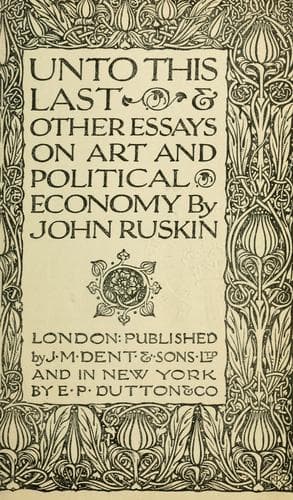
Unto This Last, and Other Essays on Political EconomyRuskin, John
General
Unto This Last, and Other Essays on Political Economy
Ruskin, John
Art; Economics
fresco of Perugino's or Giotto's, but doesn't think much of it, and
has no idea of having people coming into his cellar, or being obliged
to move his faggots; and so he whitewashes the fresco, and puts the
faggots back again; and these kind of persons, therefore, come
generally to be imaged in my mind, as the monkeys who taste the
pictures, and spit them out, not finding them nice. While, finally,
the squabbling for nuts and apples (called in Italy "bella
liberta") goes on all day long.
Now, all this might soon be put an end to, if we English, who are so
fond of travelling in the body, would also travel a little in soul. We
think it a great triumph to get our packages and our persons carried
at a fast pace, but we never take the slightest trouble to put any
pace into our perceptions; we stay usually at home in thought, or if
we ever mentally see the world, it is at the old stage-coach or waggon
rate. Do but consider what an odd sight it would be, if it were only
quite clear to you how things are really going on--how, here in
England, we are making enormous and expensive efforts to produce new
art of all kinds, knowing and confessing all the while that the
greater part of it is bad, but struggling still to produce new
patterns of wall-papers, and new shapes of tea-pots, and new pictures,
and statues, and architecture; and pluming and cackling if ever a
tea-pot or a picture has the least good in it;--all the while taking
no thought whatever of the best possible pictures, and statues, and
wall-patterns already in existence, which require nothing but to be
taken common care of, and kept from damp and dust: but we let the
walls fall that Giotto patterned, and the canvasses rot that Tintoret
painted, and the architecture be dashed to pieces that St. Louis
built, while we are furnishing our drawing-rooms with prize
upholstery, and writing accounts of our handsome warehouses to the
country papers. Don't think I use my words vaguely or generally: I
speak of literal facts. Giotto's frescos at Assisi are perishing at
this moment for want of decent care; Tintoret's pictures in San
Sebastian at Venice, are at this instant rotting piecemeal into grey
rags; St. Louis's Chapel, at Carcassonne, is at this moment lying in
shattered fragments in the market-place. And here we are all cawing
and crowing, poor little half-fledged daws as we are, about the pretty
sticks and wool in our own nests. There's hardly a day passes, when I
am at home, but I get a letter from some well-meaning country
clergyman, deeply anxious about the state of his parish church, and
breaking his heart to get money together that he may hold up some
wretched remnant of Tudor tracery, with one niche in the corner and no
statue--when all the while the mightiest piles of religious
architecture and sculpture that ever the world saw are being blasted
and withered away, without one glance of pity or regret. The country
clergyman does not care for _them_--he has a sea-sick imagination that
Public-domain text, read in full here on John Shaqi.
Reviews
Reviews
No reviews yet
Be the first to share your thoughts on this work.
Elsewhere in the archive
Join the Discussion
Join the discussion
Sign in to leave a comment or review.
Sign InorCreate an account