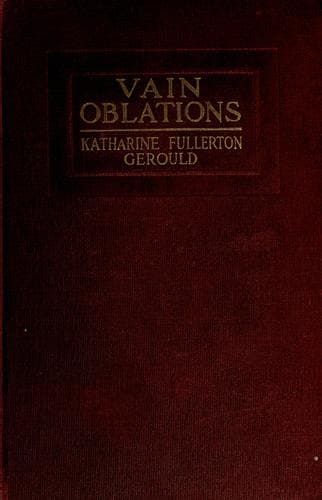
American fiction -- 20th century; Short stories, American
Chalmers ruffled both hands through his hair and leaned back from the
table. His mouth took on a legal twist. “It’s the only thing I blame
myself for--bar all the egotism that youth has to slough, and that I
think I sloughed forever before I reached the damned coast. I ought to
have known that half her impulse was the mere clinging of the frightened
child, and the other half the strangeness of our journey, which made us
both feel that all laws had ceased to work and that all signs had
failed. I ought to have reflected, to have put her off, to have made
sure, before I ever took her into my arms. And yet I’m glad I
didn’t--though I’m ashamed of being glad. Even then, you know, I didn’t
envisage the rest of life. I still thought, as for months I had thought,
that there could be no conventional future for that adventure. When my
curious _wanderjahr_ was over, I expected to die. And I wanted to have
some other face than the barren visage of Romance--the painted
hussy!--press itself to mine before I went out. I got it; and I’m not
yet over being glad, though it has made a coil that grows tighter rather
than looser with the years.”
I made no answer. There was nothing to say. He had not got to the end,
and until the end what was there for me to do but light another weary
cigarette, and summon all the sympathy I could to my non-committal eyes?
On the face of it, it was merely an extraordinary situation in which, if
a man were once caught, he could do little--a new and singular kind of
hard-luck story. But, as he told it, with those tones, those
inflections, those stresses, he certainly did not seem to be painting
himself _en beau_. I looked at the patient figure opposite me--Chalmers
always seemed pre-eminently patient--and, for very perplexity, held my
tongue.
“The next morning, I got breakfast early and went to see about my men
and beasts. I was a little afraid of finding the men drunk, but they
weren’t--only full-fed and lazy and half mutinous. The guide who had led
us to the historic spot had vanished--deserted in the night, with half
his pay owing him. No one in that black crew could explain. We had had
desertions before, and I should have considered us well enough off
simply with one coast nigger the less, if he hadn’t been my interpreter
as well. There were very few things I could say to the others without
him, and, though we were out of the woods, we were by no means done with
our retinue. I strode back to the house in a fine rage. I think I minded
the inconvenience most, since it would be the inconvenience that would
most affect her. Frankly, you see, I couldn’t suppose she felt, any
longer, a special concern with that particular black sample of human
disloyalty.
Public-domain text, read in full here on John Shaqi.
Reviews
Reviews
No reviews yet
Be the first to share your thoughts on this work.
Elsewhere in the archive
Join the Discussion
Join the discussion
Sign in to leave a comment or review.
Sign InorCreate an account