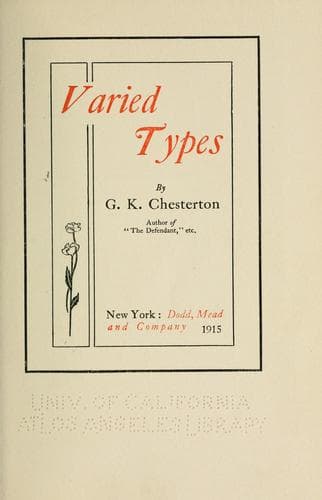
Biography; Essays; Literature, Modern -- 19th century -- History and criticism
Anyone who possesses spiritual or political courage has made up his mind
to a prospect of immutable mutability; but even in a "transformation"
there is something catastrophic in the removal of the back scene. It is
a truism to say of the wise and noble lady who is gone from us that we
shall always remember her; but there is a subtler and higher compliment
still in confessing that we often forgot her. We forgot her as we forget
the sunshine, as we forget the postulates of an argument, as we commonly
forget our own existence. Mr. Gladstone is the only figure whose loss
prepared us for such earthquakes altering the landscape. But Mr.
Gladstone seemed a fixed and stationary object in our age for the same
reason that one railway train looks stationary from another; because he
and the age of progress were both travelling at the same impetuous rate
of speed. In the end, indeed, it was probably the age that dropped
behind. For a symbol of the Queen's position we must rather recur to the
image of a stretch of scenery, in which she was as a mountain so huge
and familiar that its disappearance would make the landscape round our
own door seem like a land of strangers. She had an inspired genius for
the familiarising virtues; her sympathy and sanity made us feel at home
even in an age of revolutions. That indestructible sense of security
which for good and evil is so typical of our nation, that almost
scornful optimism which, in the matter of ourselves, cannot take peril
or even decadence seriously, reached by far its highest and healthiest
form in the sense that we were watched over by one so thoroughly English
in her silence and self-control, in her shrewd trustfulness and her
brilliant inaction. Over and above those sublime laws of labour and pity
by which she ordered her life, there are a very large number of minor
intellectual matters in which we might learn a lesson from the Queen.
There is one especially which is increasingly needed in an age when
moral claims become complicated and hysterical. That Queen Victoria was
a model of political unselfishness is well known; it is less often
remarked that few modern people have an unselfishness so completely free
from morbidity, so fully capable of deciding a moral question without
exaggerating its importance. No eminent person of our time has been so
utterly devoid of that disease of self-assertion which is often rampant
among the unselfish. She had one most rare and valuable faculty, the
faculty of letting things pass--Acts of Parliament and other things. Her
predecessors, whether honest men or knaves, were attacked every now and
then with a nightmare of despotic responsibility; they suddenly
conceived that it rested with them to save the world and the Protestant
Constitution. Queen Victoria had far too much faith in the world to try
to save it. She knew that Acts of Parliament, even bad Acts of
Parliament, do not destroy nations. But she knew that ignorance,
Public-domain text, read in full here on John Shaqi.
Reviews
Reviews
No reviews yet
Be the first to share your thoughts on this work.
Join the Discussion
Join the discussion
Sign in to leave a comment or review.
Sign InorCreate an account