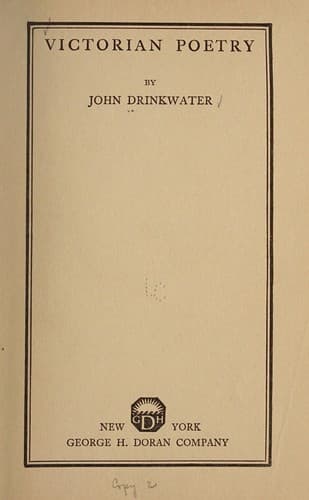
English poetry -- 19th century -- History and criticism; Great Britain -- History -- Victoria, 1837-1901
Now sweet, sweet it is thro’ the land to be straying,
’Mid the birds and the blossoms and the beasts of the field;
Love mingles with love, and no evil is weighing
On thy heart or mine, where all sorrow is heal’d.
From township to township, o’er down and by tillage
Far, far have we wander’d and long was the day;
But now cometh eve at the end of the village,
Where over the grey wall the church riseth grey.
Criticism may tell us that “the land” is an inadequate generalisation,
that to say merely that it is “sweet” to be straying through it is
to say nothing, that “the birds and the blossoms and the beasts” are
poetic counters, that “where all sorrow is heal’d” is a sentimental
_cliché_ dragged in for purposes of rhyme, that “from township to
township” makes no figure on the map, that “long was the day” is trite,
and so on to its silly heart’s content. But if, when it has finished,
it fails to perceive the living spirit of poetry in those stanzas of
Morris’s, then we at least are not called upon to waste our energy in
disputing the matter.
Tennyson’s first book (excluding the _Poems by Two Brothers_)
was published in 1830, Arnold’s in 1849, Rossetti’s in 1870, Morris’s
in 1858, and Swinburne’s in 1860, although _Atalanta in Calydon_
and _Poems and Ballads_, by which volumes the character of his
genius first fully asserted itself, did not appear until 1865 and
1866 respectively. Rossetti was six years older than Morris and eight
years older than Swinburne, but he kept his poems, though they were
well known to his friends, unpublished in book-form for many years.
Among them all, Swinburne, the youngest, is the most perplexing as
a poet. Leaving the content matter of his poetry for mention in the
proper place, we find in his manner the apotheosis of the technique of
an age, we might almost say of many ages. With a poetic scholarship
as liberal as and more widely read than Arnold’s, an ear as sensitive
to the harmonics of words as Tennyson’s, a gift of incantation as
befumed as Rossetti’s, a sense of romantic story as poignant and of
English landscape as tender and sparkling as was Morris’s, and a
metrical virtuosity that was unknown to any of them, or, indeed, to
any other English poet, Swinburne was, technically, at once the most
unoriginal and the most accomplished of the great men of his age. Of
the particular poetic beauty that we have examined in Arnold--the
beauty of “prophets and friends of God”--he had nothing; the spare
enchantment of the seventeenth-century lyric was the one eminent grace
in the stores of English poetry that he did not gather up to his own
uses. He, again, went to the sources partly through Tennyson, and,
remembering this, it would perhaps put the matter in a word to say that
it would be a safe undertaking to match any particular excellence in
Tennyson’s diction, or in that of any of the poets who were influenced
in Tennyson’s direction, with a corresponding excellence somewhere to
Public-domain text, read in full here on John Shaqi.
Reviews
Reviews
No reviews yet
Be the first to share your thoughts on this work.
Join the Discussion
Join the discussion
Sign in to leave a comment or review.
Sign InorCreate an account