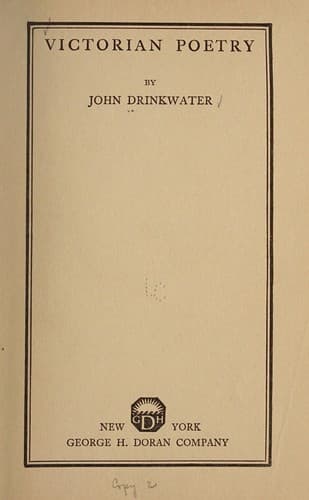
English poetry -- 19th century -- History and criticism; Great Britain -- History -- Victoria, 1837-1901
Ye rigid Ploughmen, bear in mind
Your labour is for future hours:
Advance--spare not--nor look behind--
Plough deep and straight with all your powers!
Poetry was merely an occasional occupation to Alfred Domett; he
was, nevertheless, professedly a disciple of Browning, who made him
the Waring of the poem, a fact which gives him, perhaps, a moment’s
factitious interest in a brief study of Victorian poetry. His poetic
gift was real but slightly tended, and fell into neglect in a life
of politics. His _Flotsam and Jetsam_, however, deserves some
remembrance, and the following will serve to show that his discipleship
to the great poet who was his friend was not wholly a vain one.
INVISIBLE SIGHTS
“So far away so long--and now
Returned to England?--Come with me!
Some of our great ‘celebrities’
You will be glad to see!”
* * * * *
Carlyle--the Laureate--Browning--_these!_
These walking bipeds--Nay, you joke!--
Each wondrous power for thirty years
O’er us head-downward folk
Wrapt skylike, at the Antipodes,--
Those common limbs--that common trunk!
’Tis the Arab-Jinn who reached the clouds,
Into his bottle shrunk.
The flashing Mind--the boundless Soul
We felt ubiquitous, that mash
Medullary or cortical--
That six-inch brain-cube!--Trash!
The third of the poets mentioned, T. E. Brown, is of a wider popularity
and a more distinguished talent than the others. His poems have
remained in print and still find many readers, and the reputation of
his best work is likely rather to be increased than diminished by
time. A shy and scholarly figure, he was a good democrat in his poetry
and wrote of humble lives without condescension and yet rather from a
sympathetic seclusion than as a poet of the people. Perhaps his mind
was the one of his generation in which Browning’s influence worked
to most considerable purpose, though it would be at least as true to
say in justice to a genuine but limited poet that his was a striking
instance of a smaller poetic endowment working under the same technical
instincts as the greater. In his work we find a rhapsodic note of
lyricism, a sense of dramatic antithesis, a fondness for elliptical
argument, all of which are in Browning’s habit. Brown’s touch in his
longer poems may not be as firm as the master’s, which is merely to say
unnecessarily that he was not as great a poet as Browning, but in his
shorter pieces he could often score a success in a manner that Browning
himself could hardly have used more effectively, in evidence of which
_Salve_ may be given.
To live within a cave--it is most good;
But, if God make a day,
And some one come, and say,
“Lo! I have gather’d faggots in the wood!”
E’en let him stay,
And light a fire, and fan a temporal mood!
Public-domain text, read in full here on John Shaqi.
Reviews
Reviews
No reviews yet
Be the first to share your thoughts on this work.
Join the Discussion
Join the discussion
Sign in to leave a comment or review.
Sign InorCreate an account