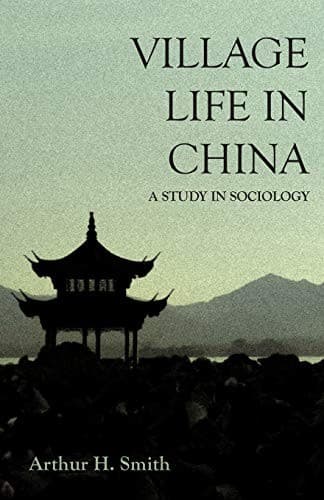
Village Life in China: A Study in SociologySmith, Arthur H.
General
Village Life in China: A Study in Sociology
Smith, Arthur H.
China -- Social life and customs; Villages
The theory upon which the master acted is happily epitomized by Ch'ên
K'ang--"distant reserve." Even to his own son the superior man is a higher
grade of being, whose slightest word contains fruitful seeds of
instruction. He expects his pupil to act upon a hint as if it were the
formal announcement of a law of nature. He is the sun around whom his
planets revolve, in orbits proportioned to the force of the central
attraction--an attraction which varies with the capacity to be attracted.
Yet in every case there is a point beyond which no pupil can go, he must
not come too near his sun.
According to Occidental thought, the ideal of teaching is exemplified in
the methods of such educators as Dr. Arnold, of Rugby, whose stimulating
influence was felt over an entire generation. Upon the plan of Confucius
it is difficult to see, not how he could have won the love of his
pupils--which was probably remote from his thought and from theirs--but
how he could have permanently impressed himself upon any except the very
apt. Few are the pupils, we may be sure, who after a chance question and a
remark will retire and study unaided a branch of learning which, they are
told, will enable them to converse, or to "establish" their characters.
Contrast with this method of Confucius that of James Mill, as detailed in
the autobiography of his son, John Stuart Mill. Here was a father, not a
professional philosopher, but a man of business, who amid the composition
of historical and other works, found time to superintend the education of
his son from the days of earliest infancy until mature manhood, not in the
ancient language only, but in history, philosophy, political economy,
composition, and even in elocution, and all with comprehensiveness of
plan, a labourious and unwearying persistence in teaching principles and
not rules, combined with scrupulous fidelity in minutest details. By this
patient assiduity and his father's skillful direction, Mill was given a
start over his contemporaries, as he himself remarks, of at least a
quarter of a century, and became one of the most remarkably educated men
of whom we have any record. One could wish that to his "imaginary
conversations of literary men and statesmen," Walter Savage Landor had
added a chapter giving a dialogue between Confucius and James Mill, "on
distant reserve as a factor in the education of sons."
It is far from being the fact that every Chinese village has its school,
but it is doubtless true that every village would like to have one, for
there is everywhere the most profound reverence for "instruction." The
reasons given for the absence of a school are always that the village is
too poor, or too small, or both.
Public-domain text, read in full here on John Shaqi.
Reviews
Reviews
No reviews yet
Be the first to share your thoughts on this work.
Join the Discussion
Join the discussion
Sign in to leave a comment or review.
Sign InorCreate an account