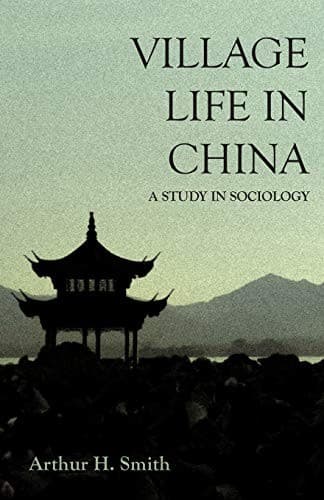
Village Life in China: A Study in SociologySmith, Arthur H.
General
Village Life in China: A Study in Sociology
Smith, Arthur H.
China -- Social life and customs; Villages
When the little pupil at the age of perhaps seven or eight takes his seat
in the school for the first time, neither the sound nor the meaning of a
single character is known to him. The teacher reads over the line, and the
lad repeats the sounds, constantly corrected until he can pronounce them
properly. He thus learns to associate a particular sound with a certain
shape. A line or two is assigned to each scholar, and after the
pronunciation of the characters has been ascertained, his "study" consists
in bellowing the words in as high a key as possible. Every Chinese regards
this shouting as an indispensable part of the child's education. If he is
not shouting how can the teacher be sure that he is studying? and as
studying and shouting are the same thing, when he is shouting there is
nothing more to be desired. Moreover, by this means the master, who is
supposed to keep track of the babel of sound, is instantly able to detect
any mispronunciation and correct it in the bud. When the scholar can
repeat the whole of his task without missing a single character, his
lesson is "learned," and he then stands with his back to the teacher--to
make sure that he does not see the book--and recites, or "backs," it at
railway speed.
Every educator is aware of the extreme difficulty of preventing children
from reading the English language with an unnatural tone. To prevent the
formation of a vicious habit of this sort is as difficult as to prevent
the growth of weeds, and to eradicate such habits once formed is often
next to impossible. In the case of Chinese pupils, these vices in their
most extreme form are well-nigh inevitable. The attention of the scholar
is fixed exclusively upon two things,--the repetition of the characters in
the same order as they occur in the book, and the repetition of them at
the highest attainable rate of speed. Sense and expression are not merely
ignored, for the words represent ideas which have never once dawned upon
the Chinese pupil's mind. His sole thought is to make a recitation. If he
is really master of the passage which he recites, he falls at once into a
loud hum, like that of a peg-top or a buzz, like that of a circular saw,
and to extract either from the buzz or from the hum any sound as of human
speech--no matter how familiar the auditor may be with the passage
recited--is extremely difficult and frequently impossible.
But if the passage has been only imperfectly committed, and the pupil is
brought to a standstill for the lack of characters to repeat, he does not
pause to collect his thoughts, for he has no thoughts to collect--has in
fact no thoughts to speak of. What he has, is a dim recollection of
certain sounds, and in order to recall those which he has forgotten, he
keeps on repeating the last word, or phrase, or sentence, or page, until
association regains the missing link. Then he plunges forward again, as
before.
Public-domain text, read in full here on John Shaqi.
Reviews
Reviews
No reviews yet
Be the first to share your thoughts on this work.
Elsewhere in the archive
Join the Discussion
Join the discussion
Sign in to leave a comment or review.
Sign InorCreate an account