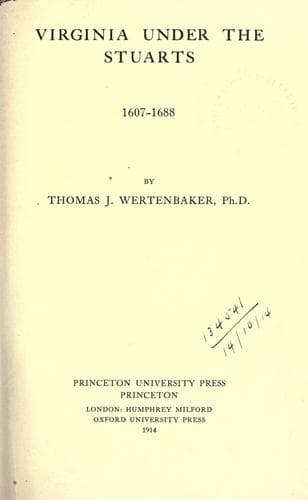
Virginia under the Stuarts 1607-1688Wertenbaker, Thomas Jefferson
History
Virginia under the Stuarts 1607-1688
Wertenbaker, Thomas Jefferson
Virginia -- History -- Colonial period, ca. 1600-1775
When the English had recovered from the first shock of the massacre,
they planned four expeditions against the tribes living on the river
above Jamestown. Mr. George Sandys attacked the Tappahatomaks, Sir
George Yeardley the Wyanokes, Captain William Powell the Chickahominies
and the Appomatocks, and Captain John West the Tanx-Powhatans. The
savages, without attempting to make a stand, deserted their villages and
their crops and fled at the approach of the English. Few were killed,
for they were "so light and swift" that the white men, laden with their
heavy armor, could not overtake them.[192] In the fall Sir George
Yeardley led three hundred men down the river against the Nansemonds and
against Opechancanough. The natives "set fire to their own houses, and
spoiled what they could, and then fled with what they could carry; so
that the English did make no slaughter amongst them for revenge. Their
Corne fields being newly gathered, they surprised all they found, burnt
the houses (that) remained unburnt, and so departed."[193]
It is remarkable that the colonists could continue this war while the
sickness was raging among them. At the very time that Yeardley was
fighting Opechancanough, hundreds of his comrades were dying "like cats
and dogs". "With our small and sicklie forces," wrote Mr. George Sandys,
"we have discomforted the Indians round about us, burnt their houses,
gathered their corn and slain not a few; though they are as swift as
Roebucks, like the violent lightening they are gone as soon as
perceived, and not to be destroyed but by surprise or famine."[194]
How bitter was the war is shown by an act of treachery by the English
that would have shamed the savages themselves. In 1623, the Indians,
discouraged by the destruction of their crops, sent messengers to
Jamestown, asking for peace. The colonists determined to take advantage
of this overture to recover their prisoners and at the same time to
strike a sudden blow at their enemy. Early in June, Captain William
Tucker with twelve well armed men was sent "in a shalope under colour to
make peace with them". On the arrival of this party at the chief town of
Opechancanough, the savages thronged down to the riverside to parley
with them, but the English refused to consider any terms until all
prisoners had been restored. Assenting to this, the savages brought
forth seven whites and they were placed aboard the vessel. Having thus
accomplished their purpose, the soldiers, at a given signal, let fly a
volley into the midst of the crowd, killing "some 40 Indians including 3
of the chiefest".[195]
Public-domain text, read in full here on John Shaqi.
Reviews
Reviews
No reviews yet
Be the first to share your thoughts on this work.
Join the Discussion
Join the discussion
Sign in to leave a comment or review.
Sign InorCreate an account