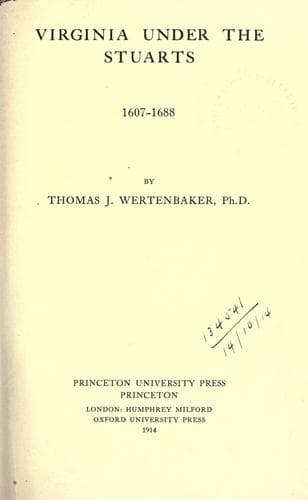
Virginia under the Stuarts 1607-1688Wertenbaker, Thomas Jefferson
History
Virginia under the Stuarts 1607-1688
Wertenbaker, Thomas Jefferson
Virginia -- History -- Colonial period, ca. 1600-1775
The massacre was followed by a venomous war with the Indians, which
lasted many years. The English, feeling that their families and their
homes would never be safe so long as the savages shared the country with
them, deliberately planned the extermination of all hostile tribes in
Virginia. Their conversion was given no further consideration. "The
terms betwixt us and them," they declared, "are irreconcilable."[186]
Governor Wyatt wrote, "All trade with them must be forbidden, and
without doubt either we must cleere them or they us out of the
Country."[187]
But it soon became apparent that neither people would be able to win an
immediate or decisive victory. The Indians could not hope to destroy the
English, now that their deeply laid plot had failed. In open battle
their light arrows made no impression upon the coats of plate and of
mail in which the white men were incased, while their own bodies were
without protection against the superior weapons of their foes. On the
other hand, it was very difficult for the colonists to strike the
savages, because of the "advantages of the wood and the nimbleness of
their heels".[188] Even though they "chased them to and fro", following
them to their villages and burning their huts, they found it very
difficult to do them serious harm.
Finally the English hit upon the plan of bringing distress upon the
savages by destroying their corn. Although the Virginia tribes subsisted
partly upon game, their chief support was from their fields of maize,
and the entire failure of their crop would have reduced hundreds of them
to the verge of starvation.[189] Each year the white men, in small
companies, in various parts of the country, brought ruin to the corn
fields. Sometimes the savages, in despair at the prospect of famine,
made valiant efforts to defend their fields, but were invariably beaten
off until the work of destruction was done.
The natives retaliated with many sudden raids upon the more exposed
parts of the colony, where they burned, pillaged and murdered. The
planter at work in his fields might expect to find them lurking in the
high grass, while their ambushes in the woods made communication from
plantation to plantation very dangerous. "The harmes that they do us,"
wrote the Assembly, "is by ambushes and sudden incursions, where they
see their advantages."[190] In 1625 Captain John Harvey declared that
the two races were "ingaged in a mortall warre and fleshed in each
others bloud, of which the Causes have been the late massacre on the
Salvages parte.... I conceive that by the dispersion of the Plantations
the Salvages hath the advantage in this warre, and that by their
suddaine assaults they do us more harme than we do them by our set
voyages".[191]
Public-domain text, read in full here on John Shaqi.
Reviews
Reviews
No reviews yet
Be the first to share your thoughts on this work.
Join the Discussion
Join the discussion
Sign in to leave a comment or review.
Sign InorCreate an account