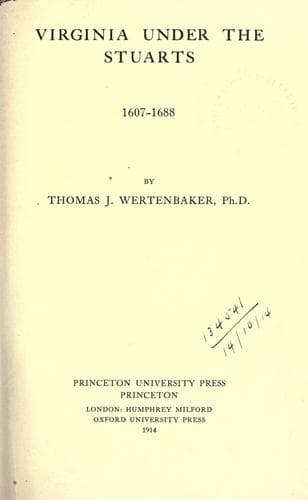
Virginia under the Stuarts 1607-1688Wertenbaker, Thomas Jefferson
History
Virginia under the Stuarts 1607-1688
Wertenbaker, Thomas Jefferson
Virginia -- History -- Colonial period, ca. 1600-1775
It seems quite certain that this treatment of the two Councillors was
designed to impress upon the people a just appreciation of the
Governor's power. Harvey felt keenly the restriction of the Council. It
had been the intention of James and after his death Charles to restore
the government of the colony to its original form, in which all matters
were determined by the Council. "His Majesties ... pleasure," wrote the
Privy Council in 1625, "is that all judgements, decrees, and all
important actions be given, determined and undertaken by the advice and
voices of the greater part."[256] If these instructions were adhered to,
the Governor would become no more than the presiding officer of the
Council. To this position Harvey was determined never to be reduced. He
would, at the very outset, show that he was master in Virginia, able to
reward his friends, or to punish those that incurred his displeasure.
Dr. Pott could not believe that the proceedings against him were
intended seriously, and, in defiance of the Governor's commands, left
his plantation to come to Elizabeth City. "Upon which contempt," wrote
Harvey, "I committed him close prisoner, attended with a guard." At the
earnest request of several gentlemen, the Governor finally consented
that he might return to his plantation, but only under bond. Pott,
however, refused to avail himself of the kindness of his friends, and so
was kept in confinement.[257] On the 9th of July he was brought to
trial, found guilty upon two indictments, and his entire estate
confiscated.[258]
That Pott was convicted by a jury of thirteen men, three of them
Councillors, is by no means conclusive evidence of his guilt. The close
connection between the executive and the courts at this time made it
quite possible for the Governor to obtain from a jury whatever verdict
he desired. In fact it became the custom for a new administration, as
soon as it was installed in power, to take revenge upon its enemies by
means of the courts.
Pott's guilt is made still more doubtful by the fact that execution of
the sentence was suspended "untill his Majesties pleasure might be
signified concerning him", while the Council united in giving their
security for his safe keeping.[259] Harvey himself wrote asking the
King's clemency. "For as much," he said, "as he is the only Physician in
the Colonie, and skilled in the Epidemicall diseases of the planters,
... I am bound to entreat" your Majesty to pardon him.[260] It would
seem quite inexplicable that Harvey should go to so much trouble to
convict Dr. Pott, and then write immediately to England for a pardon,
did not he himself give the clue to his conduct. "It will be," he said,
"a means to bring the people to ... hold a better respect to the
Governor than hitherto they have done."[261] Having shown the colonists
that he could humble the strongest of them, he now sought to teach them
that his intercession with the King could restore even the criminal to
his former position.
Public-domain text, read in full here on John Shaqi.
Reviews
Reviews
No reviews yet
Be the first to share your thoughts on this work.
Elsewhere in the archive
Join the Discussion
Join the discussion
Sign in to leave a comment or review.
Sign InorCreate an account