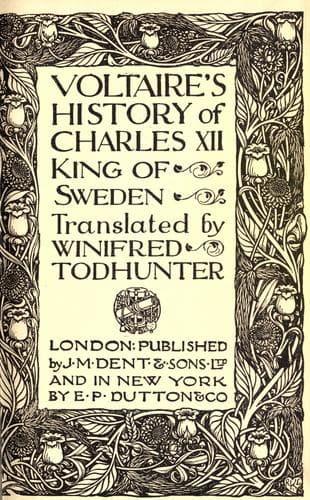
Voltaire's history of Charles XII, king of SwedenVoltaire
Philosophy
Voltaire's history of Charles XII, king of Sweden
Voltaire
Charles XII, King of Sweden, 1682-1718
These assemblies, which are unconstitutional but authorized by
precedent, are held in the king’s name, though often without his
consent and against his interests, much in the same way as the League
in France made use of Henry III’s name to undermine his power, or as
the Parliament in England, which executed Charles I, began by putting
the King’s name at the head of all the Acts they passed to destroy him.
When the troubles are ended, then it is the function of the General
Diets to annul the acts of these cabals; any Diet can also repeal the
acts of its predecessors, because one king can abolish the laws of his
predecessors, or his own laws.
The nobility which makes the laws for the State is also its defence.
They muster on horseback on great occasions, and can make a corps of
more than 100,000 men. This great body, called “Pospolite,” moves
with difficulty, and is ill-governed. Difficulties of provisions and
forage make it impossible for them to keep together long; they lack
discipline, experience and obedience, but their strong love of liberty
makes them always formidable. They may be conquered, dispersed, or
even kept for a time in bonds, but they soon shake off the yoke; they
compare themselves to reeds, which a storm will bend to the ground, and
which will rise when the wind drops. It is for this reason that they
have no fortified towns--they themselves are to be the only bulwarks of
the State; they never let their king build fortresses, lest he should
use them rather for their oppression than for their defence; their
country is quite open, except for two or three frontier towns, and
if in any of their wars, civil or foreign, they resolve to sustain a
siege, they are obliged to hastily raise earth fortifications, repair
old half-ruined walls, and enlarge the half-choked ditches; then the
town is taken before the entrenchments are finished.
The Pospolite is not always on horses to guard the country; they only
form by order of the Diet, or, in times of great danger, by that of the
king.
The ordinary protection of Poland is in the hands of a force which the
State is obliged to support. It is composed of two bodies independent
of each other under two different generals. The two generals are
independent of each other, and though they are nominated by the king,
are responsible to the State alone and have supreme authority over
their troops. The colonels are absolute masters of their regiments,
and it is their affair to get them what sustenance they can, and to
pay them; but as they are seldom paid themselves, they ravage the
country, and ruin the farmers to satisfy their own rapacity, and that
of their soldiers. The Polish lords appear in these armies with more
magnificence than in civil life, and their tents are finer than their
houses. The cavalry, which makes up two-thirds of the army, is almost
entirely composed of noblemen, and is remarkable for the gracefulness
of the horses and the richness of the accoutrements.
Public-domain text, read in full here on John Shaqi.
Reviews
Reviews
No reviews yet
Be the first to share your thoughts on this work.
Join the Discussion
Join the discussion
Sign in to leave a comment or review.
Sign InorCreate an account