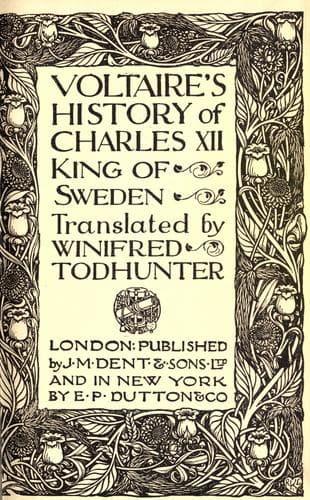
Voltaire's history of Charles XII, king of SwedenVoltaire
Philosophy
Voltaire's history of Charles XII, king of Sweden
Voltaire
Charles XII, King of Sweden, 1682-1718
Their men-at-arms especially, who are called either hussars or
pancernes, are always attended by several valets, who lead their
horses, which have ornamented bridles with plates of silver and silver
nails, embroidered saddles, saddle-bows and gilt stirrups, sometimes
made of massive silver, with saddle-cloth trailing in the fashion of
the Turks, whose magnificence the Poles imitate as nearly as possible.
But though the cavalry is so gorgeous the foot are wretched, ill-clad,
ill-armed, without uniform clothes or anything regular; at least
that is how they were up to 1710. These foot-soldiers, who are like
wandering Tartars, bear hunger, cold, fatigue, and all the hardship
of war with incredible endurance. The characteristics of the ancient
Sarmatæ, their ancestors, can still be seen in the Poles; the same lack
of discipline, the same fury in assault, the same readiness to run away
and to return to the field, the same mad fury of slaughter when they
are victorious.
The King of Poland at first consoled himself with the idea that these
two armies would fight for him, that the Polish Pospolite would arm at
his orders, and that all these forces, united with his Saxon subjects
and his Russian allies, would make up a multitude before whom the small
Swedish force would not dare to appear. But he saw himself suddenly
deprived of this means of succour through the very pains which he had
taken to have them all at once.
Accustomed in his hereditary dominions to absolute power, he was
perhaps too confident that he could govern Poland like Saxony.
The beginning of his reign raised malcontents, his very first acts
irritated the party which was opposed to his election, and alienated
almost all the rest. The Poles resented the fact that their towns
were filled with Saxon garrisons and their frontiers with troops. The
nation, far more anxious to maintain their own liberties than to attack
their neighbours, did not consider the king’s attack on Sweden and
his invasion of Livonia as advantageous to the State. It is difficult
to deceive a free nation concerning its interests. The Poles saw that
if this war, undertaken against their wishes, was unsuccessful, their
country, unprotected on every side, would fall a prey to the King of
Sweden, and that if it succeeded they would be subdued by their own
king, who as soon as he was master of Livonia as well as Saxony would
be able to hem in Poland between these two countries.
Public-domain text, read in full here on John Shaqi.
Reviews
Reviews
No reviews yet
Be the first to share your thoughts on this work.
Join the Discussion
Join the discussion
Sign in to leave a comment or review.
Sign InorCreate an account