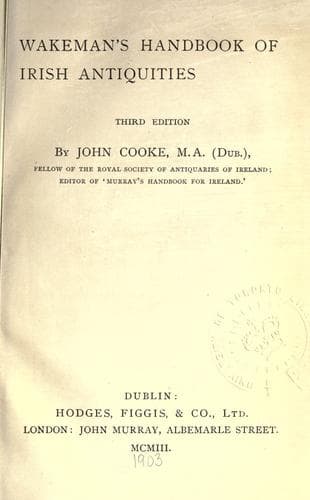
Wakeman's handbook of Irish antiquitiesWakeman, W. F. (William Frederick)
History
Wakeman's handbook of Irish antiquities
Wakeman, W. F. (William Frederick)
Ireland -- Antiquities
As in the case of other rocks, traditions of heroes and saints are
sometimes attached to these stones. The late Rev. F. Sherman gives the
following instance: Mesgegra, king of Leinster in the first century
of the Christian era, was slain and decapitated by Conal Cearnach,
the champion of Ulster. The head was laid upon a stone, and the tale
records ‘that the blood flowed through it to the ground.’ The stone
is said still to remain in the stream opposite the ruins of the
Franciscan church of Clane. ‘It is a bullán stone, and has an inverse
conical cavity eighteen inches deep, and as many wide, on its upper
surface.’[22] An interesting legend is attached to the ‘Deer-stone’
in Glendalough, Co. Wicklow. It is said that St. Kevin once found an
infant abandoned by its mother; his anxiety to procure it food was
relieved by the appearance of a beautiful white doe, that was then, and
afterwards daily, milked into the ‘Deer-stone.’ The antiquity of the
stone is doubted.
Bulláns are found in pairs, as at Kill o’ the Grange, near Blackrock,
Co. Dublin; in threes, as close to the ancient church of Templenaffrin,
adjoining Belcoo, Co. Fermanagh; and in numbers up to nine. Of the
large number that are to be found scattered throughout the country,
two very striking examples of the class deserve special notice. In
the townland of Meelehans, about three miles from Tullamore, is
a _nine-holed_ bullán. This is a fossiliferous limestone boulder,
differing from the limestone of the surrounding district. On the
face of the rock from which the earth had been removed, in a radius
of three feet, circular hollows were found. Four of these measured
one foot in diameter; two were smaller, and the depth was about half
the diameter; a seventh was but partially cut: the dressing of these
being smooth. The remaining two were natural depressions.[23] Another
nine-holed bullán lies upon the shore of Upper Lough Macnean, near
the ancient church of Killinagh, and in the immediate vicinity of a
well called ‘Tober Brigid,’ formerly, and we believe still, held very
sacred by many of the neighbouring peasantry.[24] The bullán is a
round boulder of red sandstone, measuring 5 feet 9 inches by 5 feet
2 inches. On its somewhat table-like surface are nine hollows placed
somewhat irregularly, one being nearly in the centre of the group.
Each of the depressions contained a stone, generally of an oval form,
and nearly filling the hollow. Superstitious beliefs and practices
still linger round many of these stones; and many bulláns are found
associated with certain springs or wells usually esteemed holy, but the
special significance of these associations it is now difficult, if not
impossible, to determine.
CHAPTER II
STONE MONUMENTS--_continued_.
Public-domain text, read in full here on John Shaqi.
Reviews
Reviews
No reviews yet
Be the first to share your thoughts on this work.
Join the Discussion
Join the discussion
Sign in to leave a comment or review.
Sign InorCreate an account