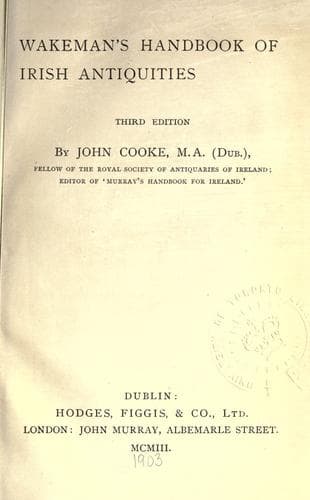
Wakeman's handbook of Irish antiquitiesWakeman, W. F. (William Frederick)
History
Wakeman's handbook of Irish antiquities
Wakeman, W. F. (William Frederick)
Ireland -- Antiquities
SEPULCHRAL REMAINS--CISTS--THE CROMLECH--KERNANSTOWN--LABBACALLEE--
MONASTERBOICE--GREENMOUNT--CROMLECH OF THE FOUR MAOLS--BLACK
LION--LEGANANNY--BALLYMASCANLAN--PHŒNIX PARK CISTS--HOWTH--
KILTERNAN--MOUNT VENUS--SHANGANAGH--BRENNANSTOWN (GLEN DRUID)--
GLENSOUTHWELL--GLENCULLEN BALLYEDMOND--SHANKILL--KNOCKMANY--
CLOGHTOGH--SLIEVEMORE--LENNAN--CASTLEDERG.
It is now admitted by all competent authorities that the works
scattered throughout Ireland, varying from the rude structures known as
cromlechs and the gigantic chambered cairns, like those of Newgrange
and Dowth, down to the simplest cist, alike varieties of the cromlech
idea, are graves of a primitive people. But we may go a step further
than this. It is perfectly evident that the people who erected the
cromlechs and tumuli were far more solicitous about the abodes of the
dead than they were regarding their own dwellings, built as these were
of wood and wattles, covered with turf and earth, and subject to ready
decay. ‘On the other hand,’ as Dr. Munro well says, ‘the tomb was
constructed of the most durable materials, and placed on an eminence,
so as to be seen from afar, and to be a lasting memorial among
succeeding generations.’[25]
Towards the close of the Stone Age the custom of burning the bodies of
the dead was practised by the inhabitants of the British Isles. The
dead were also disposed of by ordinary burial, by placing the body in
either a horizontal, sitting, or perpendicular position. Both methods
were practised throughout the whole succeeding archæological period, or
Bronze Age, as numerous remains testify. When cremated, the calcined
remains were placed in an urn, and then deposited, often with a small
food-vessel, within an artificial chamber. This is called a _Cist_,
or _Kistvaen_, and is usually a small rectangular chamber made of
flags or rude stones. Over these chambers it was often customary to
raise a cairn of stones or earthen mound. The cist has, however, been
frequently found in open fields and other unexpected places. Cinerary
urns, too, have been found within an area of stone circles, in tumuli
not many feet from the surface, and in mounds that in their centre
contained other, and probably more ancient, burial deposits.
Public-domain text, read in full here on John Shaqi.
Reviews
Reviews
No reviews yet
Be the first to share your thoughts on this work.
Join the Discussion
Join the discussion
Sign in to leave a comment or review.
Sign InorCreate an account